Products / Character and mascot
Character And Mascot Plush
Two documented pairs show what actually changes when a drawn character becomes fabric: a koala in a white garment, and a robed figure whose artwork and sample are both shown from the front. Each pair puts the drawing beside the sewn sample so the difference is visible rather than described.
What These Samples Show
Both examples are design-to-sample pairs from the same workshop.
A character brief fixes a silhouette, a proportion and a few identifying cues. The pairs below show how that translated: the koala keeps a rounded head and its garment reads as a separate layer over the body; the robed figure shows one front view only, so the reverse construction is not documented here.
Read them as construction evidence, not as client work. Both images carry ‘your design / our sample’ labels on the artwork itself; neither carries an order reference, and neither is presented as a delivered programme.
What the pairs cannot tell you is how a different character will behave. That depends on feature size, pose and surface, which is what the comparison below is for.
Images are displayed as supplied. They are not cropped or retouched.
Design Beside Sample
Two pairs, both from the supplied product photography.
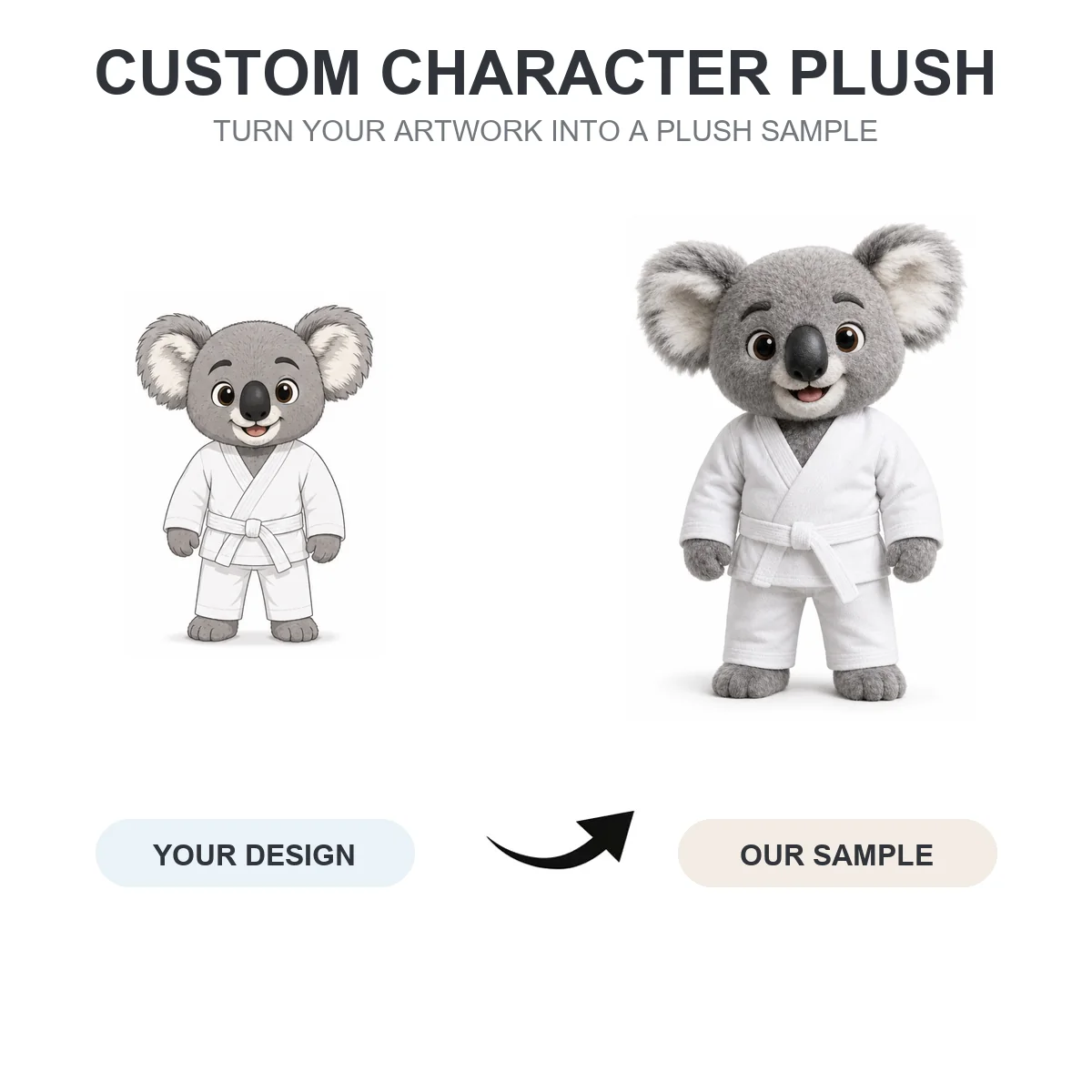
Koala In A White Garment
The left figure is flat artwork; the right is the sewn sample. The head reads larger in the sample than in the drawing, and the white garment sits over the body as a visible layer.
- Reference
- Koala character, design and sample
- Observed detail
- Rounded head, low ear placement, garment built as separate pieces rather than printed
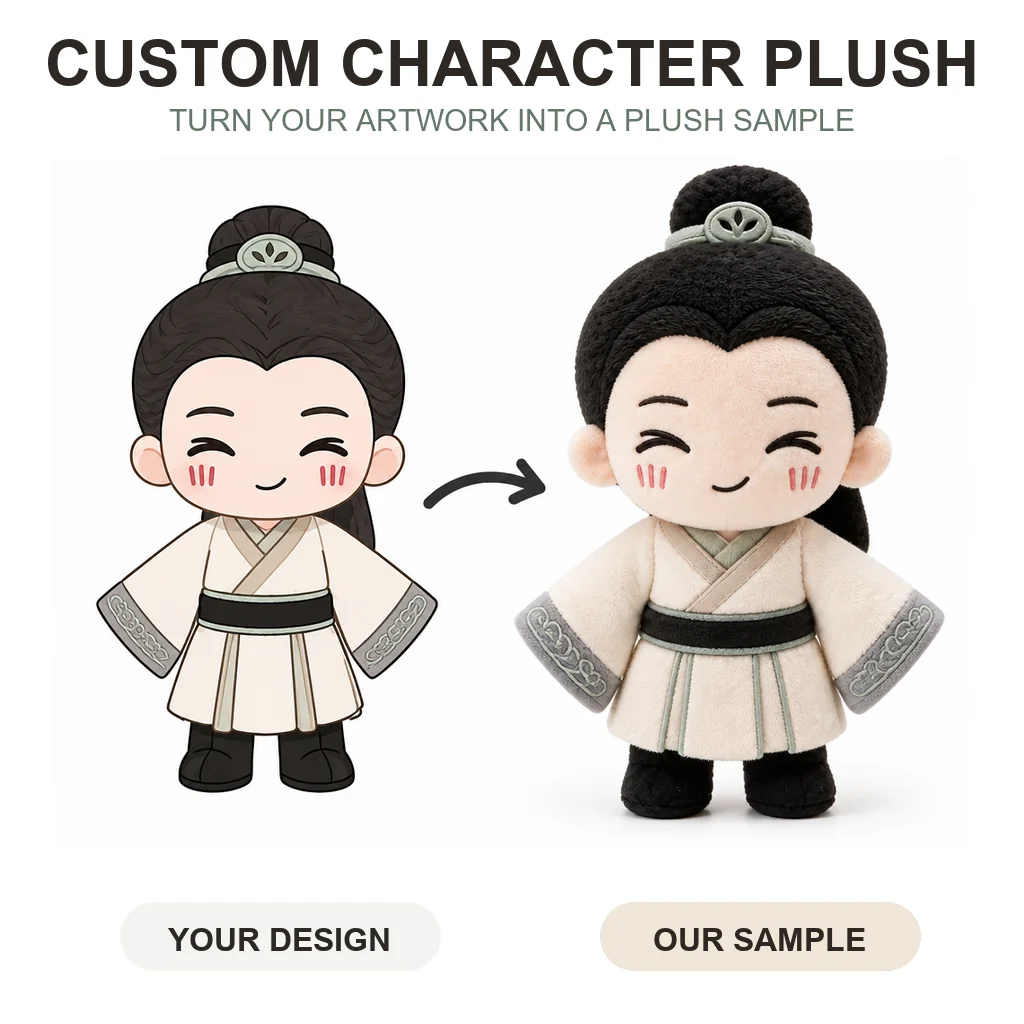
Robed Figure, Front View
The left figure is flat artwork; the right figure is the sewn sample. Both show the same front view, so the belt, the crossed collar and the wide sleeve can be compared, while the reverse, the closure and any lining are not visible in this file.
- Reference
- Robed figure, design and sample
- Observed detail
- Front view only; crossed collar, belt and wide sleeve visible; reverse not shown
What Changed Between Drawing And Sample
Read from the two pairs above.
| Decision Point | What To Confirm | Why It Matters |
|---|---|---|
| Head Proportion | The sewn head reads larger than the drawing in both pairs. | Whether that difference is intended should be confirmed at sampling. |
| Garment Construction | Both garments read as a layer over the body; how they are closed is not visible from the front. | Closure and lining have to be specified, not copied from the photo. |
| Facial Detail | Eyes and mouth are stitched rather than printed; fine line work in the drawing is not reproduced. | Sets the minimum size at which the face reads. |
| Views Supplied | Only a front view exists for either pair; no reverse photograph is included. | A one-view brief leaves the back to be designed. |
Before You Ask For A Sample
Photographs show the finished piece, not the inside: head-to-body ratio and whether the body is jointed has to be confirmed on the sample or in the brief rather than read from a picture.
- Proportion and size: state the finished height or length you need.
- Surface and craft: say whether the look depends on pile, print or embroidery.
- Build detail for this form: Character & Mascot Customization.
What To Decide Before Sampling
Decisions that change the pattern rather than the decoration.
Pose and structure come first. Standing and seated figures need different patterns, and whether a figure needs extra support is settled at sampling rather than from a photo.
Then surface. Pile length changes how a face reads and how seams sit; the koala sample uses a short pile, which keeps the face legible.
Finally, how the garment is made. Whether it is fixed at the neck or closed at the back changes the pattern, and the photos here do not show that decision.
Where This Connects
The category page, the sampling process and the artwork checklist.
The category page covers what is made; this page covers what the samples show.
Character Plush Questions
Can You Work From A Single Front View?
It can start, but the back has to be designed by someone. Neither pair on this page includes a reverse photograph, so this page cannot show how the back was resolved.
Will The Sample Match The Drawing Exactly?
It will match the parts that survive fabric. On both pairs the sewn head reads larger than the drawing and fine line work simplifies; the garment becomes a layer rather than printed shading.
Are These Delivered Client Projects?
No. They are design-to-sample comparisons from the workshop’s product photography, and no client, order or approval is claimed for them.
Can You Make A Plush Based On A Book Character?
Only if the rights are cleared. A book character usually reaches us as reference art plus a style guide, and the approval route sits with the publisher or author. This page does not state whether any example shown is licensed; that has to be confirmed per project.
Send The Character And Its Views
A front, a side and a note on the pose is enough to judge feasibility.