Custom plush · Dolls & cotton dolls
Custom Plush Dolls & Cotton Dolls
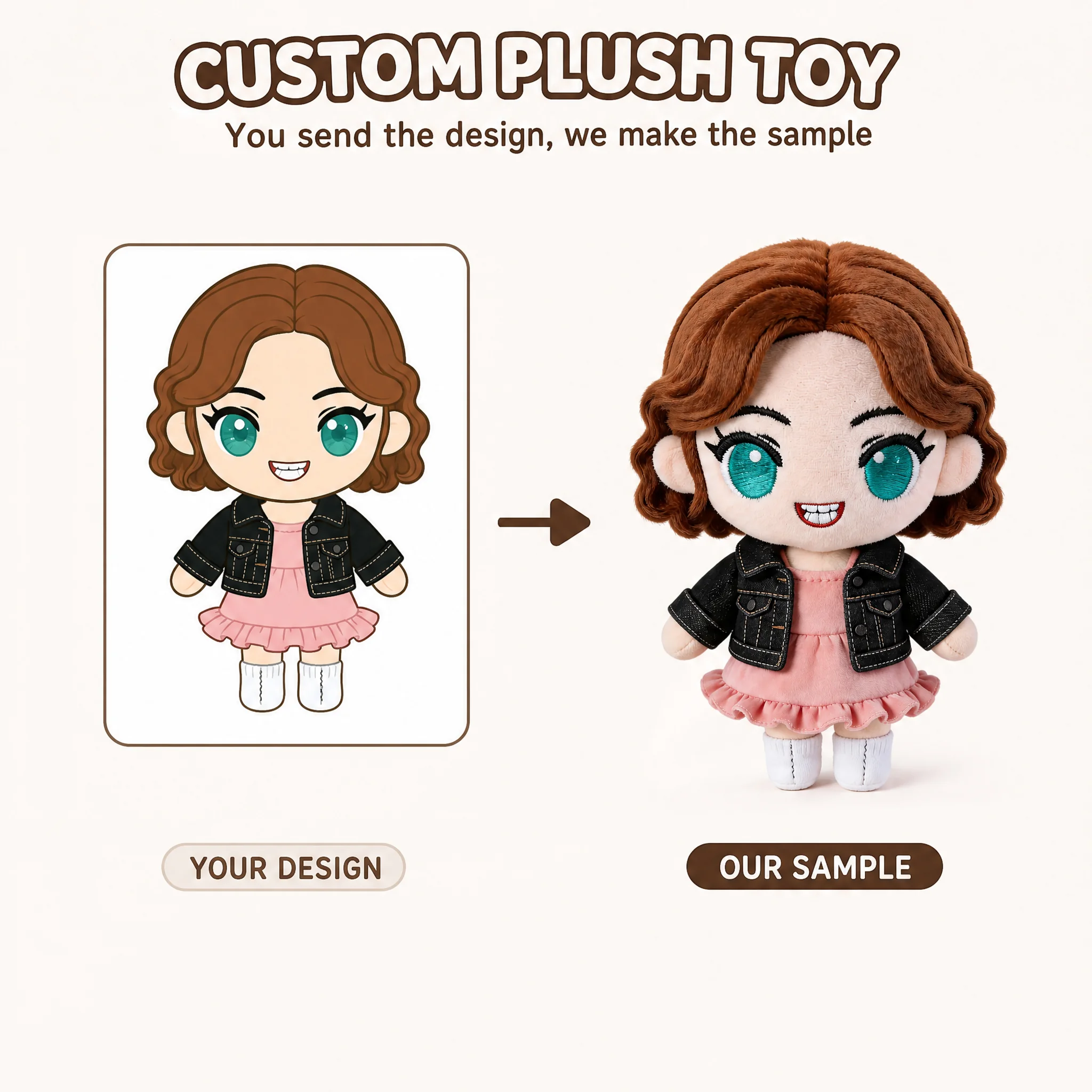
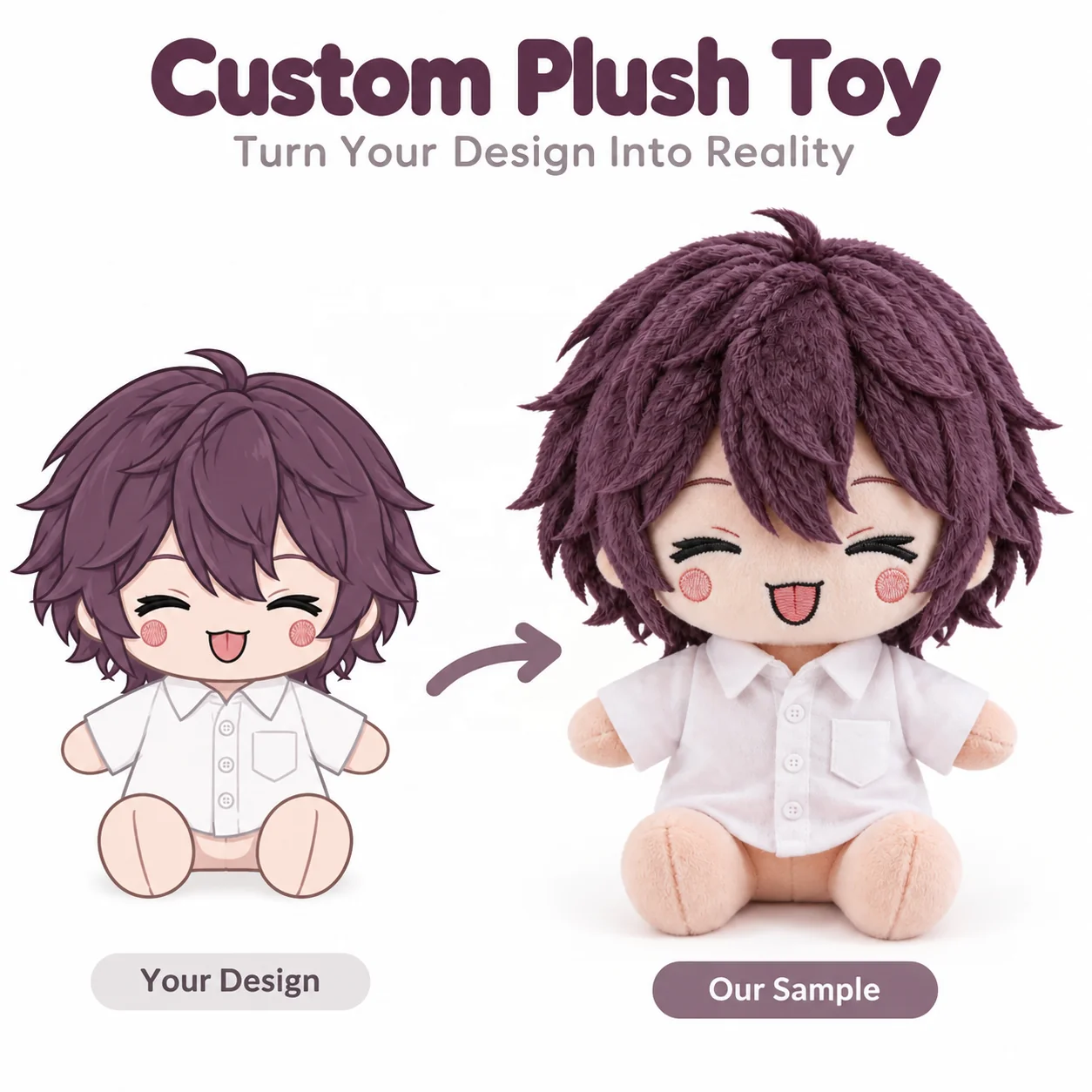
Orui Toys develops custom plush dolls and cotton dolls from your artwork or an approved sample. Plan the head-to-body proportion, the embroidered face, the outfit and any removable parts, then review the sample and the requirements for production. Share your design, the intended use and the target market to begin.
For buyers comparing plush doll manufacturers, Orui Toys works as an OEM/ODM plush manufacturer. The in-house project team coordinates assessment, pattern and sample development, sourcing, production and inspection, while embroidery, printing and part of the sewing are carried out with controlled partner workshops. Development can start from a design, a physical sample or an existing pattern.
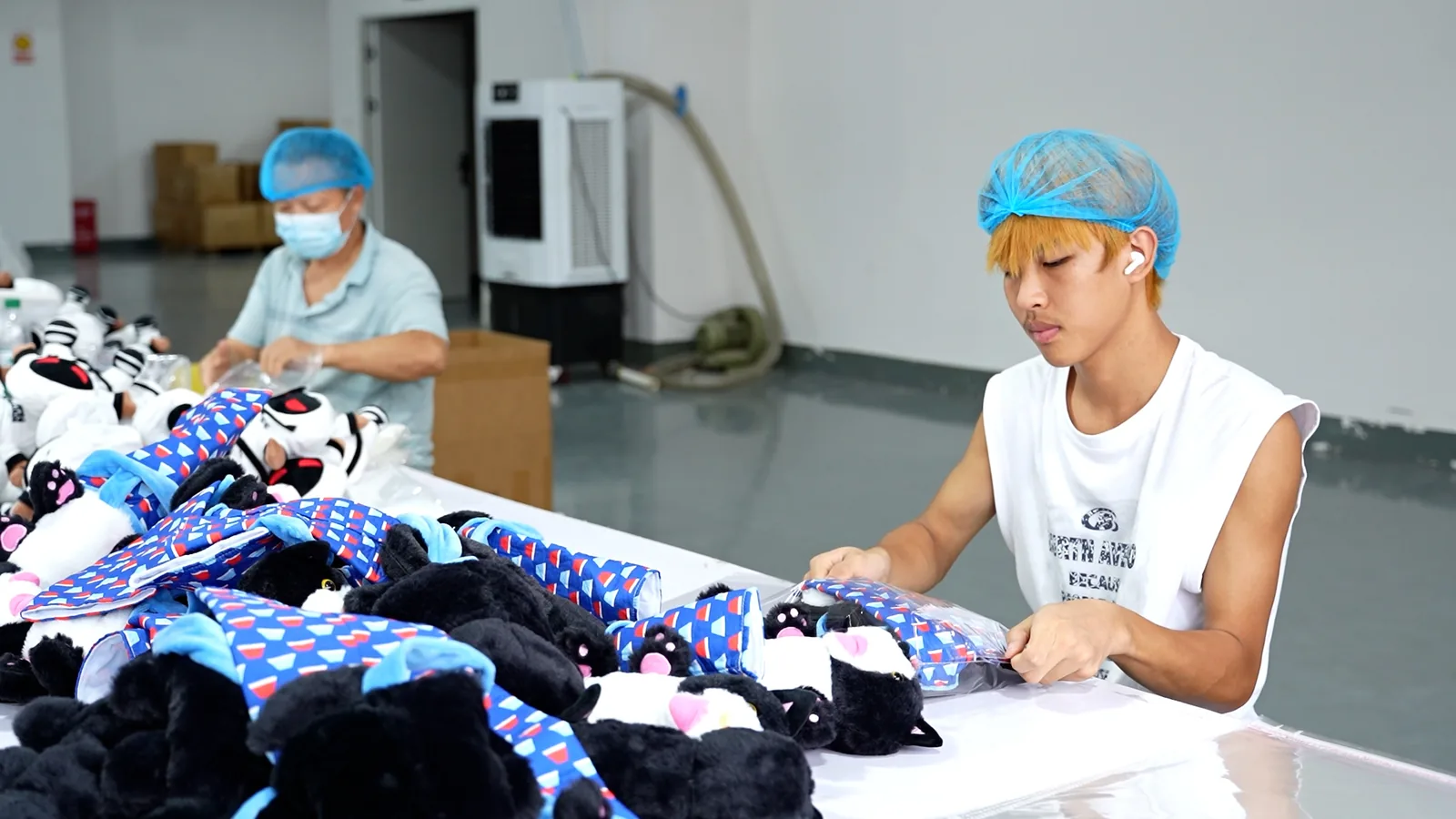
Dolls are finished by hand at the end of the line. The photograph illustrates construction only; it does not document a named customer project or equipment ownership.
Which Doll This Page Covers
This page is about the doll form itself: plush dolls and cotton dolls, including dressed, dress-up and jointed variants. It is separate from the character, mascot and licensed-character pages, which are about the artwork a doll may carry. Here the questions are the body proportion, the face, the clothing, the removable parts and how the sample is approved.
Cotton dolls is the common name for this doll style. The name alone does not fix the fabric, the filling or the construction, and it is not a claim that the doll is made of 100% cotton. The shell fabric, the filling and any internal structure are confirmed for the specific design and its target market.
Cotton dolls, jointed or armature dolls and children’s dolls are handled as separate cases rather than one uniform product type. Whether an item is sold as a children’s toy, an adult collectible or a promotional item is agreed at the start, because it changes the materials, the small-part review and the test requirement. Dolls intended for infants or children under three are not promoted as a stable capability.
What To Send For A Doll Brief
A useful brief for a custom plush doll identifies the doll you want, the proportions that must be recognisable and the parts that will be added or removed. Start with the artwork or sample you have and mark anything that is still undecided.
Starting Points We Can Work From
- Hand drawing or concept artwork
- 2D views: front, side and back
- Reference photographs of the intended doll
- An existing pattern or a physical sample
- A complete tech pack
- A 3D file as an appearance reference
A 3D file is an appearance reference only. It is not converted directly into a production pattern: the doll structure is developed separately as measurable sewn pattern pieces, so a 3D file does not replace pattern engineering and does not by itself create a pattern.
What The Brief Should Describe
- Front, side and back views, plus a close-up of the face and expression
- Head-to-body ratio and key measurements: overall height, width and depth
- Standing or sitting pose and how the doll should stand unaided, if required
- Clothing and accessories, and which parts are sewn on or removable
- Colour references as Pantone codes or physical colour cards
- Fill feel, target age group, sales market and any test requirement
- Quantity for each size or outfit, and the required date and destination
- The person who consolidates feedback
Where only a single front view exists, the doll can still be assessed, but the pattern maker will need to ask about the parts the drawing does not show.
Size And Head-To-Body Proportion
The head-to-body ratio, the outer silhouette and the limb length define a doll more than a single overall height does. These proportions are fixed on the pattern and re-checked at the intended size, because a doll that reads well at one size does not always read the same way when it is scaled.
- One size, one pattern review: a different size is not a scaled copy. The pattern breaks, the fill amount and the small parts are re-checked, and the new size is sampled and approved on its own.
- Smallest and largest sizes: very small and oversized dolls each present their own constraints, so a size is confirmed only after the design and the intended use are assessed for the project.
- Standing and sitting: the pose and any support the doll needs are decided at pattern stage, alongside the intended size.
Head-to-body ratio is only one of three decisions. The body length sets how much doll there is below the head, and the amount of fill sets how firm the body reads: a lightly filled body slumps and softens the outline, a firmly filled body holds the pose and can make a small head look smaller. The three are judged together on the sample, because a ratio that reads well on the drawing can look top-heavy or stiff once the body is stuffed. Figures for height, body length and fill are the ones on your own size chart; this page does not publish a standard range.
What Each Choice Changes
| Choice | Options To Settle | What It Changes In Sampling And Quote |
|---|---|---|
| Proportion | Head-to-body ratio and limb length | Pattern drafting and balance; the sample is judged on proportion first |
| Size | Doll height | Fabric use and whether the outfit can be sewn at that scale |
| Surface | Skin fabric and hair material | Hand feel and how the face takes embroidery |
| Craft | Fixed or removable outfit; hair rooting or wig | Outfit pieces and closures add patterns and a separate approval |
Faces And Expression
On a doll the face carries most of the character, and it is usually where detail and overall shape conflict. Embroidery is the established route for defined eyes, brows and small graphic marks, with stitch density and placement checked on the intended fabric. Printing represents surface colour areas and graphics, and appliqué or panel construction creates layered looks with a slight relief rather than a flat surface.
Fine expressions compete with head shape, pile direction and small parts. Where an illustration relies on hairline detail, compare simplified linework on the sample and confirm that the intended expression is still recognisable. Very dense or very fine line work has practical limits at small sizes.
Eyes: Sewn In Or Fitted
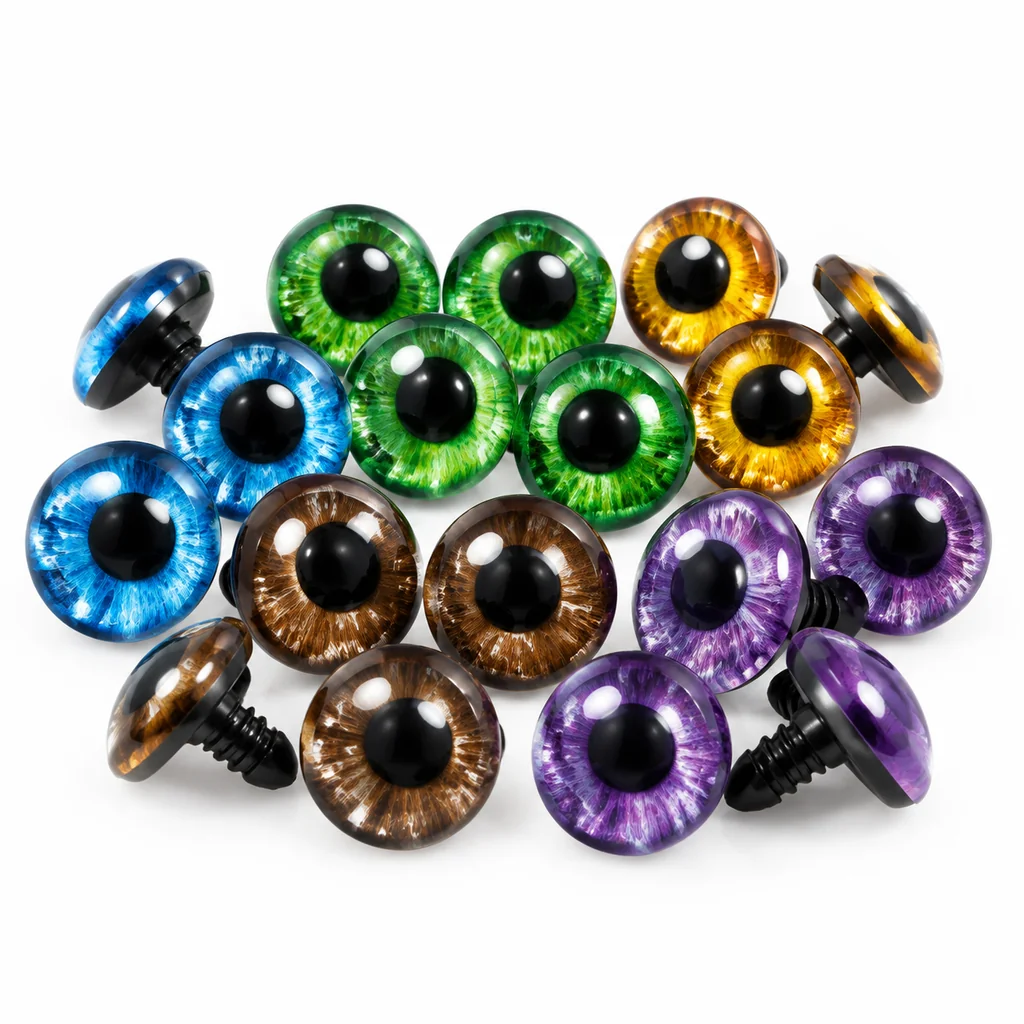
Eyes are the second decision. An embroidered eye is sewn into the face and carries no separate part; a fitted eye is a component fixed through the fabric and is reviewed as a small part. The choice changes the look, the pattern and the age review, so it is made with the face drawing rather than after the sample. Where the expression depends on a highlight or a fine lash line, that detail is tested on the stitch-out before the sample is built.
The method for eyes, nose and any added parts is agreed per design, because plastic or fitted features affect the small-part and age review rather than being a purely visual choice.
Clothing, Outfits And Accessories
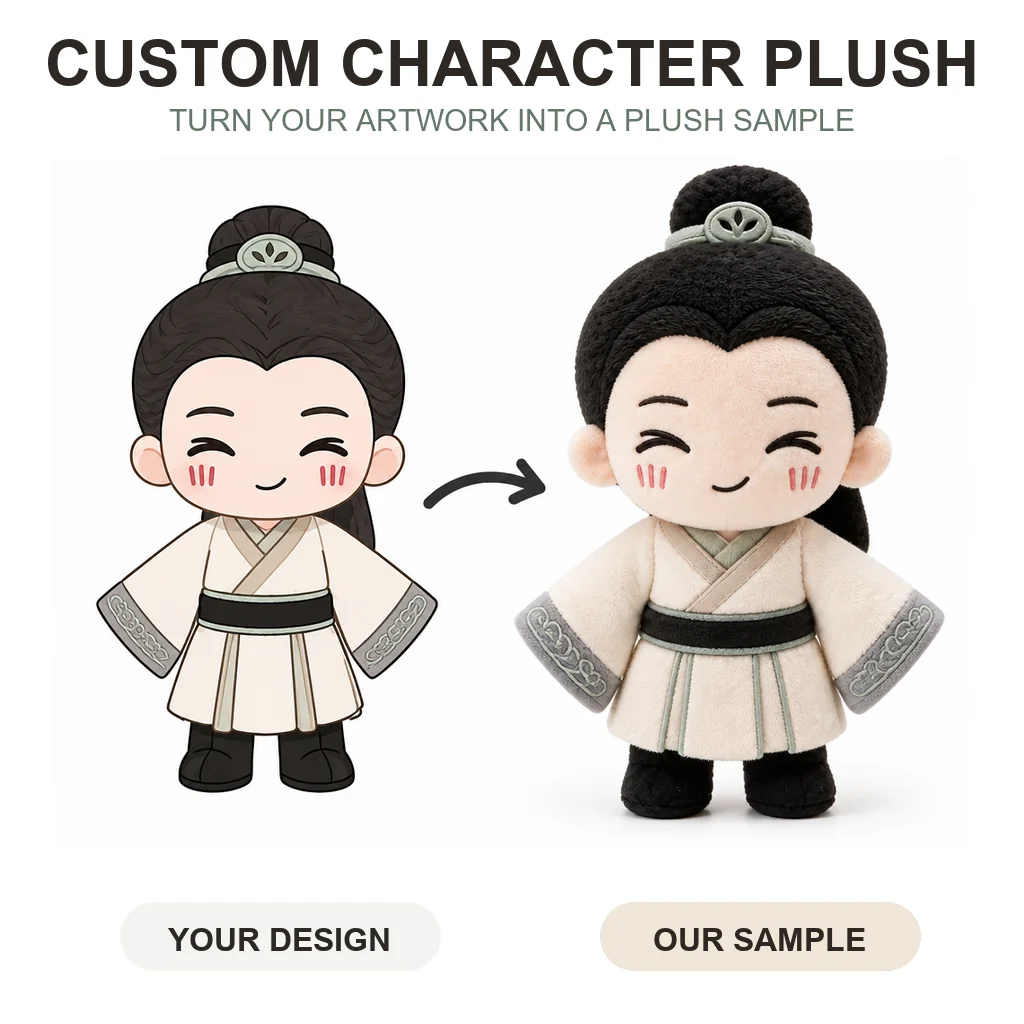
Outfits are planned as part of the doll rather than added afterwards. Garment panels, seam lines, closures and attachment points are decided at pattern stage so the clothing sits correctly on the finished body and the silhouette is not lost under the fabric.
Fit Is Checked On The Doll, Not On The Drawing
A garment that looks right as artwork can still pull at the neck, twist at the armhole or sit too long once it is on a filled doll body. Fit is therefore reviewed on the sewn doll against the agreed measurements, and the pattern is adjusted before the sample is approved. Where the body size changes, the garment pattern is re-checked for the new body rather than scaled with it.
What Each Outfit Still Carries
- Its own pattern pieces where the garment shape changes from the body
- Its own colour and material references, approved against physical cards
- Garment tolerances checked on the sewn result, not only on the drawing
- A closure method agreed by design, whether sewn on, hook-and-loop, button or another fitting
Planning A Range Of Outfits
A series keeps the shared proportions, colour references and face style fixed, then lists what changes for each outfit or variant. Each variant records its own pattern pieces, material references and approval points, so a second or third outfit does not silently alter the doll it was built for. Quantity and schedule for a series are confirmed per project, because the number of styles, colours and packaging options changes what a run requires.
Accessories
Hats, bags, footwear and held props are reviewed as part of the doll. Removable accessories are treated as small parts and are considered in the age and safety review, and their attachment points are decided before sampling. Tell us which accessories are meant to be taken off and put back on, because that decision affects both the construction and the age review.
Where A Doll Design Goes Next
The same doll design can extend to a smaller charm or keyring format, and those formats are planned on Plush Dolls & Cotton Dolls references and the keychain and bag charm page.
Removable Parts And Jointed Structure
Whether an outfit is sewn on or removable is a design decision with a safety and a cost effect, so it is settled before sampling rather than after. Removable garments and small accessories are patterned together with their attachment method, and their attachment points are decided at pattern stage so they sit correctly on the finished body.
- Removable clothing: hook-and-loop, buttons or other fittings are agreed for the design, and the opening is tested on the sample.
- Small parts: removable accessories are reviewed for small-part and age considerations, because a removable part affects the risk and the age or use assessment. The final product classification follows the doll’s overall intended use and the requirements of the target market.
- Jointed construction: joint or armature structure is assessed per project against the design and the intended use. It is not presented as a fixed standard capability, and the internal structure is confirmed before a sample is committed.
- Age decisions: where a project targets young children, the removable-part decision is part of the age and test review for the intended market.
Comparing The Two Constructions
Compare a fixed, sewn-on outfit with a garment made as separate pieces: where the opening and closure sit, and which parts stay sewn to the doll.
Fixed outfitSewn and finished on the doll; the closure and inside finish are part of the pattern.Separate piecesA shirt and shorts made as their own pattern pieces and finished on the sample. Whether an outfit is sewn on or made to come off is agreed per project and checked on the sample.Four Details That Decide A Doll
Proportion, face, outfit and the removable question are decided together, because a change to one moves the others. These are the four points to settle before a sample is made, with the section that covers each one.
- Detail 1
Head, Body And Fill
Agree the head-to-body ratio, the body length and how firm the fill should be. Confirm them on the sample by eye and against your size chart. Size and proportion
- Detail 2
Face And Expression
Agree eye type, eye spacing, brow angle and mouth line, and whether the eyes are embroidered or fitted. Confirm the face on the curved head, not on the flat drawing. Faces and expression
- Detail 3
Outfit And Fit
Agree garment panels, closure position and how the outfit sits on the filled body. Confirm neckline, armhole and hem on the doll. Clothing and outfits
- Detail 4
Sewn On Or Removable
Agree whether the outfit is fixed or removable before patterning, because the opening, the closure and the small-part review all follow from it. Removable parts
Approving The Sample
A doll sample is judged on more than one photograph, because shape, size, colour, fill and clothing are separate decisions that can each go wrong independently. The confirmation method below is a practical approach we propose; the exact evidence and the approval steps are agreed for your project rather than applied as a fixed standard.
- Check 1
Overall Proportion
Compare the head-to-body ratio, body length and limb length with the approved drawing at the same size, and judge the fill firmness in the hand. Confirm the doll holds the agreed pose.
- Check 2
Front, Side And Back
Ask for all three views at the same distance, plus a three-quarter view. Check the profile, the back of the head and how the body sits, not only the front the artwork shows.
- Check 3
Clothing Opening And Fit
Check the neckline, armhole, hem and closure on the filled body. Where the outfit is removable, take it off and put it back on and confirm the opening still closes and the garment returns to position.
- Check 4
Accessories And Series Consistency
Check that each accessory sits at the agreed point, and compare the second or third doll in the series against the first: same face position, same proportions, same colour blocks.
How Each Check Is Confirmed
- Shape and expression: multi-angle photographs, a 360° video or a video call.
- Size: ruler photographs and a measured size table against the agreed dimensions.
- Colour and fabric: physical material cards and Pantone references; screen colour is a reference only.
- Fill and clothing: a physical sample with fill weight and softness references, and the outfit checked on the doll.
How Decisions Can Be Recorded
Consolidate comments into one dated response for each sample version. Separate a correction against the agreed brief from a new design, size, material or function request, and confirm the included revisions and any cost or schedule change in the project terms.
Identify the approved physical sample, its version and the approval date as the production reference, often called a golden sample. Agree who holds it, how long it is kept and how changes are recorded; those details are confirmed for the project and are not a fixed company figure. If materials, structure, clothing or packaging change, confirm whether a revised sample and renewed approval are needed before production.
Your Artwork And Confidentiality
Before sending unreleased artwork, discuss the NDA, the permitted recipients and any restriction on photographs or sample display. The points below are the terms we propose; the final wording is agreed for your project and recorded in the contract.
- NDA: a bilateral non-disclosure agreement can be signed by Dongguan Orui Toys & Gifts Co., Ltd. or the actual contracting entity. A customer template can be reviewed, and the signing entity and the terms are confirmed for the project.
- Ownership: for your original or licensed project you keep the rights to your characters, logos and original designs. The permitted use, ownership and delivery scope of production files such as patterns and bills of materials are agreed in the contract.
- No reuse: nothing is displayed or reused beyond the agreed project without written permission from the relevant rights holder.
- Lawful basis: a doll may reproduce a character only where the project has a lawful basis. Requests to copy a protected character or brand without permission, or to remove or imitate branding to avoid obtaining permission, are declined or deferred until the rights basis is resolved.
For character, anime and game projects that need a fuller discussion of rights verification, see Custom Anime & Game Plush.
Before A Doll Run Starts
Production Approval Checklist
These are the items to agree and freeze before a production run is authorised:
- Final bill of materials, pattern and size chart
- Colour and material standards, compared with approved physical references
- Embroidery or printing files, and special-part specifications
- Process route and key quality points
- Labels, barcodes, individual packaging and carton requirements
- Test plan for the target market and age group
When The Production Schedule Starts
Agree the scheduling start conditions in the quotation or order. The start conditions are agreed in the quotation or order: the approved sample, the confirmed order, any agreed deposit, the frozen materials, the packaging and label data, and the agreed test plan. They are a project arrangement rather than a published rule, so confirm them for your order. Design or order changes need a fresh timing assessment, and no single lead time applies to every project.
Testing
Orui can coordinate applicable testing with an accredited third-party laboratory according to the product, the intended age and the destination market, and can confirm the applicable requirements, costs and report scope for the project. A report applies only to the products and materials it covers, and documents can be shared after their scope and permission to disclose are confirmed. See Quality & Safety for the broader topic.
Inspection Steps
Inspection points can be agreed for incoming material, first article, in-process work and finished goods, checked against the approved sample and specification. For doll products this includes facial placement, garment fit, attachment points and the correct version of labels and packaging. Sampling rules, defect grading and release authority are set out in the inspection specification agreed for the project.
Explore Related Products And Project Guidance
Use this page for the doll form itself, including proportion, clothing and sample approval. These related pages help with the other parts of a brief:
- Custom Plush overview — the range of custom plush work and how to choose a category.
- Custom Character & Mascot Plush — original characters and mascots, where the artwork is the starting point.
- Custom Anime & Game Plush — rights-based character projects and rights verification.
- Plush Dolls & Cotton Dolls references — browse the related product category.
- Plush Keychains & Bag Charms — where a doll design is extended to a smaller charm or keyring format.
- Design to Sample — the wider development route from a first concept to an approved sample.
Custom Plush Doll Questions
Can The Same Doll Be Produced In More Than One Size?
Yes, where the pattern allows it. A different size is not a scaled copy: the proportions, pattern breaks, fill amount and small parts are re-checked for the new size, and the new size is sampled and approved on its own before it goes into a run.
How Are Quantity And Schedule Decided?
Custom orders start from 1 piece, and there is no ready stock; a single piece also goes through sampling or production, with cost and lead time confirmed for the project. Material purchasing minimums are separate from the 1-piece product minimum. They depend on the design and pattern complexity, the size, fabric and custom-colour minimums, embroidery or print set-up, special parts, the number of styles and colours, packaging and any test requirement. Tell us the quantity you need, even if it is one piece, and ask for the quotation, sample cost and timing for that specification.
Can A Doll Be Made For Children Under Three?
Dolls for infants or children under three are not promoted as a stable capability. They are only accepted after the specific design, materials, construction and test requirements for the market have been confirmed, and no small removable part is assumed to be acceptable.
Is The Outfit Sewn On Or Removable?
That is a design decision, not something a photograph can show. A fixed outfit is sewn onto the doll as part of the finished piece; a removable outfit needs its own opening and closure and a small-part review for the intended age. Tell us which one the project needs before sampling, because the pattern and the sample check differ.
Can One Outfit Be Used On Two Doll Sizes?
Not automatically. A garment pattern is built for one body, so a change of doll size or fill means the neckline, armhole and hem are re-checked for the new body rather than scaled with it. The pattern may need adjusting, and the fit is confirmed on a sample for the new size instead of being assumed from the first one.
Can The Same Doll Be Made With Different Expressions?
Yes, where the design allows it. Each expression is its own face file and its own approval, and the differences are confirmed on the sample. Where several dolls belong to one series, the face position and proportions are compared across the pieces so the range still reads as one family.
What About Testing For My Market?
Agree the testing requirement for the product, the intended age and the sales market. Orui can coordinate testing discussions with an accredited third-party laboratory, and can confirm the applicable requirements, the costs and the report scope for your project.
Can You Show Dolls You Have Made For Other Clients?
The images on this page are visual references for doll form, clothing and construction, not verified customer case studies. A named project, brand relationship or character licence is not implied. Ask which additional references may be shared and confirm the relevant display permission before treating them as project evidence.
Discuss This Product
Send your doll design or sample, the clothing and removable-part requirements, the intended use and the target market. We will confirm what is needed for the first feasibility assessment and the sample plan.
Use Request a Quote to review the project details and prepare your brief. For current enquiries, email landy@oruitoys.com with your project brief.