Custom Plush › Pillows & Cushions
Custom Plush Pillows & Cushions
A custom plush pillow is judged on three things at once: whether the shape still reads once it is filled, whether the surface detail survives handling, and whether the carton delivers it in the state you approved. This page covers the decisions that have to be settled before a pattern is cut.
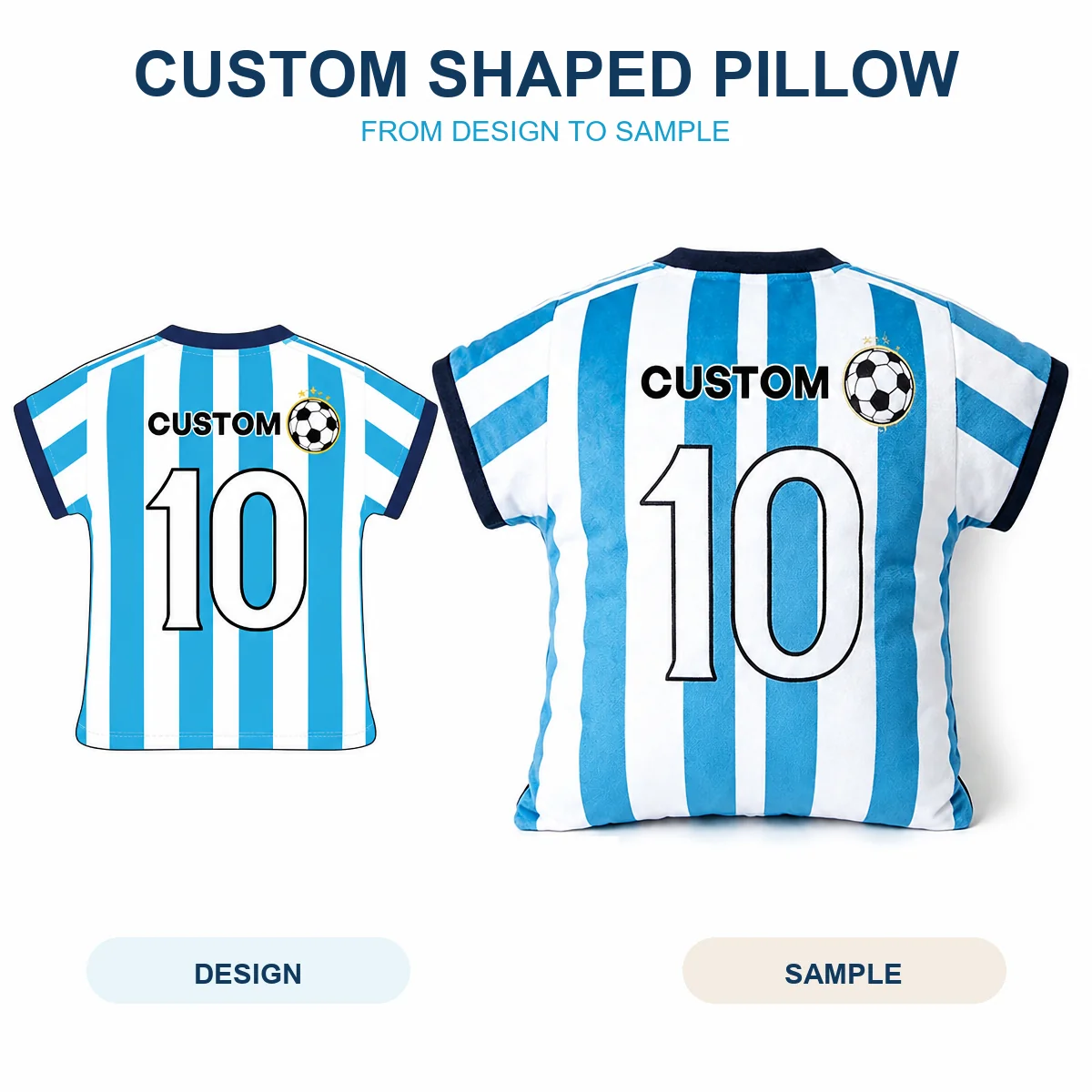
Character pillows, silhouette pillows and cushions, developed from your artwork or a physical sample.
Finished width, height and thickness, the face technique, fill weight and distribution, cover construction, and the packing method.
Send views, dimensions, colour references, the feel you want, intended use, market, age and quantity. We will say what is still missing.
Scope
Which Plush Pillow And Cushion Projects This Page Covers
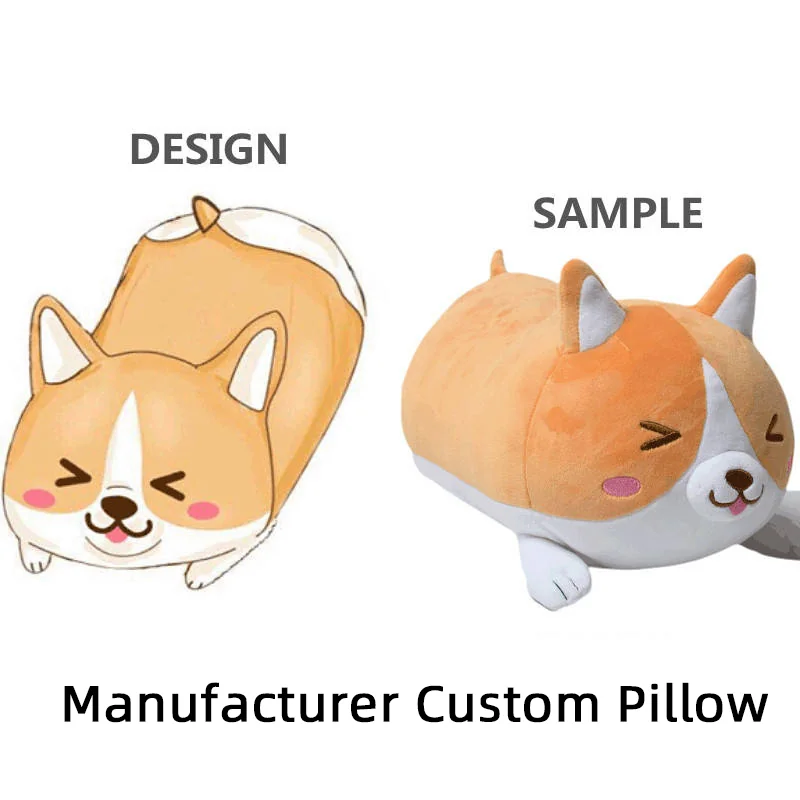
Plush pillows and cushions are one of our standing product categories, alongside character plush, keychains and bags. A project usually starts the same way as any custom plush: artwork or a physical sample comes in, a pattern is built, a sample is approved, and the approved version becomes the reference for production. What differs is that the object is mostly surface and fill, so the pattern has to carry a large printed or embroidered face across a shape that is about to become three-dimensional.
This category is usually prepared for brand merchandise, home gifting and retail programmes. Designs generally start from one of the shapes below, and each one brings a different question to the pattern.
Character Face Pillows
A flat panel with a face on it. The design question is how much of the character survives when the panel is sewn, filled and pressed.
Silhouette Pillows
Cut to the outline of a shirt, fruit, animal or logo. Narrow sections and small limbs are where a pattern usually has to be adjusted.
Cushions
Round, square or wedge shaped. Thickness and edge finishing carry more of the design than facial detail does.
Not this page: browsing ready styles belongs to the Products category for plush pillows and cushions, which is still being prepared. Generic character and mascot development sits under Custom Plush. Floor cushions, mattresses and ordinary bedding are outside this category, and weighted, scented, magnetic or heatable versions are not standard capability.
Pattern making, cutting, sewing, embroidery, printing and filling run through production partners inside our Dongguan Chashan production system. How each step is scheduled, checked and accepted, and who signs it off, is agreed for the project.
Shape and size
Shape And Size: What The Pattern Has To Carry
A pillow is drawn flat and judged in three dimensions. Three dimensions define the object: finished width, finished height, and finished thickness. Thickness is the one most often left out, and it changes how large the face reads, how the outline curves, and whether the pillow stands or slumps when it is put down.
Give the finished width, height and thickness, not the size of the drawing. If the pillow is meant to sit against something, say what, because that shapes the fill decision discussed further down. It also helps to say where the shape may flex: a pillow allowed to soften at the corners is a different pattern from one that must hold a straight edge.
Points To Settle At Pattern Stage
- Narrow necks and thin joins: seam allowance and reinforcement are decided with the pattern maker.
- Sharp points and thin tips: the sewn and filled result may sit blunter than the drawing.
- Small ears, tails and limbs: these may need to be widened, shortened or made as separate pieces.
- Detail finer than the pile: it may not read on the finished surface.
These are best settled before the first sample, since changing them afterwards normally means another round.
What One View Leaves Open
A single front view can be assessed, but the pattern then rests on assumptions about what the back, the side and the base look like. Expect questions back: how deep the body is, whether the back is plain or printed, and how the shape should sit.
A front, side and back set with key dimensions answers more of those questions before patterning starts. It does not remove them entirely, and it is not a substitute for the sample.
Face and graphics
Face And Graphics: Embroidery, Print Or Pieced Panels
The method follows the artwork. Four routes are common on pillows, and each carries a different trade-off that has to be confirmed against the actual material rather than decided from a picture.
| Technique | Suits | What To Confirm |
|---|---|---|
| Embroidery | Eyes, mouths, outlines, small marks, single-colour logos | Dense fills can stiffen the panel and add weight; very fine lines may not read in the pile |
| Screen printing | Flat colour areas, simple shapes, larger graphics | Ink sits on the surface, so gradients and hairlines can break up; the colour count affects the print set-up |
| Pieced panels | Solid colour blocks, layered characters, appliqué detail | Every join adds a seam that shows in the silhouette and changes the feel |
| Laser-cut appliqué | Felt-like shapes with clean edges, small repeat motifs | Edge finish and heat marks vary by material, so the fabric needs testing first |
Placement is the second decision. On a shaped pillow the face sits on a curved surface, so artwork drawn flat has to be adjusted for the curve, or features can shift once the panel is filled. On a silhouette pillow the print also has to stay clear of the seam line.
Colour is best confirmed on a material card or a Pantone reference. A screen preview is a reference only, because pile depth, sheen and the base fabric all shift the result.
Filling
Filling: Weight, Feel And Keeping It Even
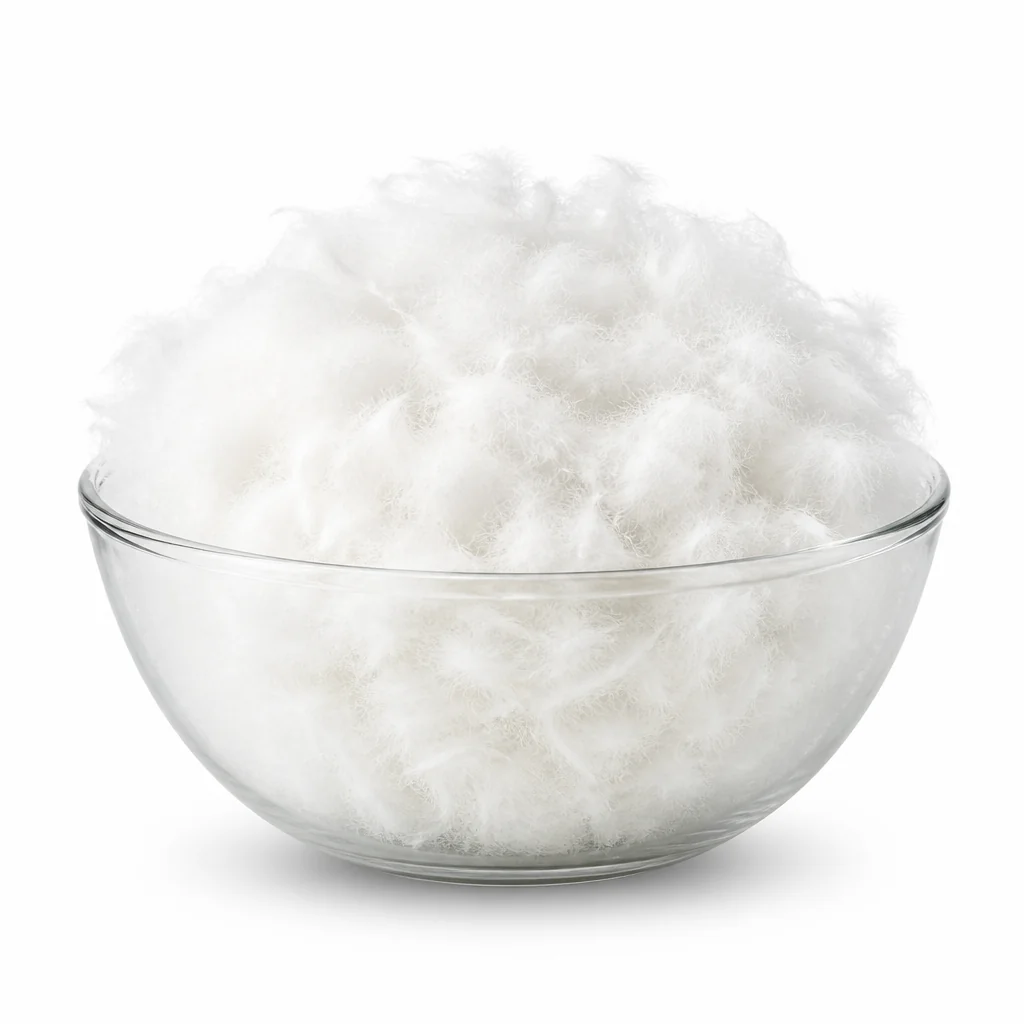
Filling is a specification, not a default. The material and the amount are agreed against the feel and the weight you want, and confirmed on the sample rather than assumed from a photo. A pillow that should feel soft and squashy and one that should hold a firm edge are not the same build even when the drawing is identical.
The specification should set three things: the target feel in plain words, the target weight of the finished piece, and whether the pillow should hold its shape or give when pressed. Those three drive the fill amount, and the fill amount drives whether the silhouette stays true.
Where Fill Drifts
Corners, limbs and long narrow sections are the areas to check first for fill, because that is where it moves. Filling by hand at the machine is not the same as filling to a target weight.
The checks worth agreeing for a project are a target weight and distribution, a first-piece comparison against the approved sample, and whichever in-process check the project needs. The last adjustment happens at hand closing, where fill can still be moved. Frequency and tolerance depend on the size and the fill, so they are set with the project rather than published as one figure.
The Recurring Risks
The risk list recorded for this category names filling uniformity, dimensional resilience after packing, colour fastness across batches, and care labelling. Filling uniformity and dimensional resilience are evaluated at sampling against criteria agreed with the buyer; colour fastness and care labelling depend on the material evidence behind them. Neither is settled by wording alone.
None of them can be judged from a photograph, so the physical sample and the weight record carry the confirmation.
Cover and cleaning
Cover, Closure And Cleaning: A Project Decision
A closed pillow and a pillow with a separate cover are different builds, not two options on the same pattern. A removable cover is not a standard construction here. If a separate cover is part of your design, treat it as a feasibility question: whether it works for your shape, size and fabric, and what closure and finish it would need, has to be confirmed before it is quoted.
The closure type, a concealed zip, a visible zip, buttons or an overlap, changes the seam line and how the cover sits once filled. That is settled on the sample, because the same closure behaves differently on a 30 cm cushion and on a long body pillow.
On care wording: a care instruction is a statement about a material combination, and changing the cover fabric, the fill, the closure or the market can change what may be said. Washing, allergy and flame-resistance claims must be confirmed for the specified build, with applicable evidence, before they are used on a label or a page. Until that evidence exists for the build and the market, the wording stays neutral.
Where a buyer needs a specific care statement for retail, the practical route is to fix the materials first, then agree the wording. Wording carried over from a different product is the usual source of trouble.
Packing
Packing And Compression: What Survives The Carton
Vacuum packing equipment is part of the production set-up, and compression is often the difference between a workable freight cost and an unworkable one on a large pillow. It is not without trade-offs. Compression suits resilient filled plush; it carries risk on long pile, moulded faces, printed surfaces, hard or shaped parts, complex poses and premium gift presentation.
Before compression is accepted for a product, the packing method should be validated: pack a production-representative sample at the intended pressure, carry it through a transport duration comparable to the real shipment, then record size, appearance and feel at intervals after opening. That validation, and who signs it off, is agreed as part of the project. If the pillow does not return to the approved sample, a different packing method is used for it.
What Compression Is For
- Reducing carton volume on large, softly filled pillows.
- Bringing freight volume down, which is usually why the question comes up.
Where It Needs A Different Answer
- Long pile that can stay flattened along a seam.
- Moulded or stitched faces that can crease along a fold.
- Printed panels where the ink can crack at a crease.
- Gift packaging where the pillow has to arrive presentation-ready.
Where compression is wrong for the product, the alternatives are an individual bag, a retail-ready box or a flat carton, chosen against the freight cost and how the pillow has to look when the carton is opened.
Sample to batch
From Sample Approval To A Consistent Batch
The approved sample is the reference everything is compared against. The approval step should record a project number, a version and an approval date, and name what the sample is approved for, so production and inspection compare against a defined object rather than a conversation. Anything that is not visible in a single photograph, such as fill feel or how the edge sits, lives in that physical sample.
Confirmation normally combines multi-angle photos or video for shape and face, a size sheet for dimensions, material cards or Pantone references for colour, and a physical sample for feel. Which of those the approval relies on is agreed per project, because each covers a different failure and none replaces the others.
Revision rounds are agreed in the quotation. A change of size, material, artwork or closure is normally a new round rather than a correction, so it helps to collect comments into one set of feedback per round and to say which changes are approved.
Colour Across Batches
Pile and dye lots shift. The material card, not the screen, is the reference, and a change of fabric or colour changes the approved version.
Pile Direction
Panels cut in different directions can read as different shades under light. Cutting direction is set at pattern stage and confirmed on the sample.
Fill Weight And Print Position
Both drift quietly. Both are compared with the approved sample, which is why the weight record and the print placement belong in the approval.
Intended use
Intended Use Decides The Labels And The Test Plan
The first question about a pillow is not what it looks like but what it is. A pillow sold as a children’s toy, one sold as a decorative home textile, one given away at a trade fair and one sold as a pet product carry different obligations, and the same physical object can fall into different categories depending on age, packaging and how it is presented.
Intended use, target age and sales market are therefore agreed as part of the project, before the test plan and the labelling are fixed. Projects are usually prepared for the United States, the European Union, the United Kingdom, Canada, Australia, Germany and France.
What Testing Covers
Applicable testing is coordinated with recognised third-party laboratories according to the product, the target age and the market. CE/EN71, CPC/ASTM F963, CPSIA or REACH requirements can be confirmed at project start; which standards apply, and what a report covers, follows the design, the materials, the market and the final report.
Reports and compliance documents can be shared where permission and confirmed scope allow.
What A Certificate Covers
A certificate belongs to a product, a material and a market, not to a catalogue. A report for one build is not extended to another, so the applicable scope is written into the project documents and checked against the order before it is relied on.
Products for infants and children under three are not a standing capability. They would need separate confirmation of design limits, component limits and test evidence before any commitment.
Starting point
What To Send With Your Enquiry
The list below is what turns an enquiry into a quotation. With it we can assess feasibility, propose a pattern approach and quote; without it we can only give an initial view.
- The design. Artwork, a reference photo, an existing pattern or a physical sample.
- Views and dimensions. Front, side and back, with finished width, height and thickness.
- Colour. Pantone references or a physical swatch.
- Surface. Which parts are embroidered, printed, pieced or appliquéd.
- Fill. The feel you want and the weight you expect, if you have a target.
- Cover. Closed, or a separate cover with a closure.
- Use and market. What the pillow is, who it is for, the target age and the country of sale.
- Quantity, packaging and date. Including whether compression packing is required.
- Authorisation. Confirmation that you hold the rights to any character, logo or artwork supplied.
Custom orders start from 1 piece, and there is no ready stock; a single piece also goes through sampling or production, with cost and lead time confirmed for the project. We quote the sample cost, production cost and lead time for the specification you send.
Questions
Custom Plush Pillow Questions
Can You Work From A Single Front View?
Yes, with a caveat. One view can be assessed, but the pattern then rests on assumptions about the depth, the back and how the base sits. Expect questions back before patterning, and treat the first sample as carrying more open questions than one built from a front, side and back set with dimensions.
Can The Cover Be Removable, And Can The Pillow Be Washed?
A removable cover is not a standard construction here. It is a feasibility question for the project: whether the shape, size and fabric allow it, and what closure and finish it would need, are confirmed before it is quoted. Washing depends on the exact materials, the closure and the market, so care wording is agreed against the specified build rather than assumed.
How Do You Keep The Filling Even In A Shaped Pillow?
By agreeing the checks with the project: a target weight and distribution, a first-piece comparison against the approved sample, and whichever in-process check the order needs. Corners, limbs and narrow sections are where fill moves, and the last adjustment happens at hand closing. Tolerance and frequency follow the size and the fill.
Will Vacuum Packing Flatten The Pillow?
It can, which is why the packing method should be validated before it is accepted. A production-representative sample is packed at the intended pressure and carried through a comparable transport duration, then size, appearance and feel are recorded at intervals after opening. If it does not return to the approved sample, another packing method is used.
Do You Provide Certificates For The Pillow?
Applicable testing is coordinated with recognised third-party laboratories according to the product, target age and market. CE/EN71, CPC/ASTM F963, CPSIA or REACH requirements can be confirmed at project start, and reports can be shared where permission and confirmed scope allow. A certificate covers a specific product, material and market, so the scope is confirmed per project rather than presented as a range-wide certification.
What About A Cat Pillow Or Another Animal Shape?
The same questions apply to a custom cat plush pillow as to any other silhouette: how thin the limbs can be, how the face sits on a curved surface, and how the shape holds once filled. An animal shape may need some simplification at pattern stage, which is decided with the pattern maker before the first sample.
What Quantity And Lead Time Should I Plan For?
Both follow the specification: pattern complexity, size, fabric minimums, print or embroidery set-up, trims, colour count, packaging and testing all Sample cost and lead time are confirmed for the project.
Send The Drawing, Or Send The Sample
Either is a valid starting point. A drawing gets a feasibility view and a list of what is missing; a physical sample gives the pattern something concrete to work from.
The Request a Quote page is still being completed and its form is not live yet. If you would rather not wait, write to landy@oruitoys.com or call +86 189 2825 9221 with the details above.