Products / Backpacks and bags
Plush Backpacks And Bags
A plush backpack is a bag wearing a plush body. The load decides the pattern: where the load enters the body, whether an inner layer is needed, and what the hardware is fixed into. Three design-to-sample pairs follow.
Why A Bag Is Not A Plush Toy With Straps
The load decides the construction.
A soft toy carries its own weight; a bag carries a laptop, books or a change of clothes. That difference is what has to be settled before a pattern is cut: where the load enters the body, whether an inner layer is needed, and what the hardware is fixed into.
It also changes where mistakes show. A plush toy hides a puckered seam in the pile; a bag shows it as a curved edge that will not sit flat once loaded.
Three design-to-sample pairs are shown below. They document the outside of a finished bag: silhouette, surface, zip route, strap and hardware. They do not show the inside, so lining, fill, panel layout and where the strap is anchored stay open questions on this page.
The photographs show the outside of the samples only; internal construction is not documented here.
Three Pairs, Three Shapes
Each drawing is shown beside the sewn sample. The drawings stand; the samples read as seated bags.
Orange Dinosaur
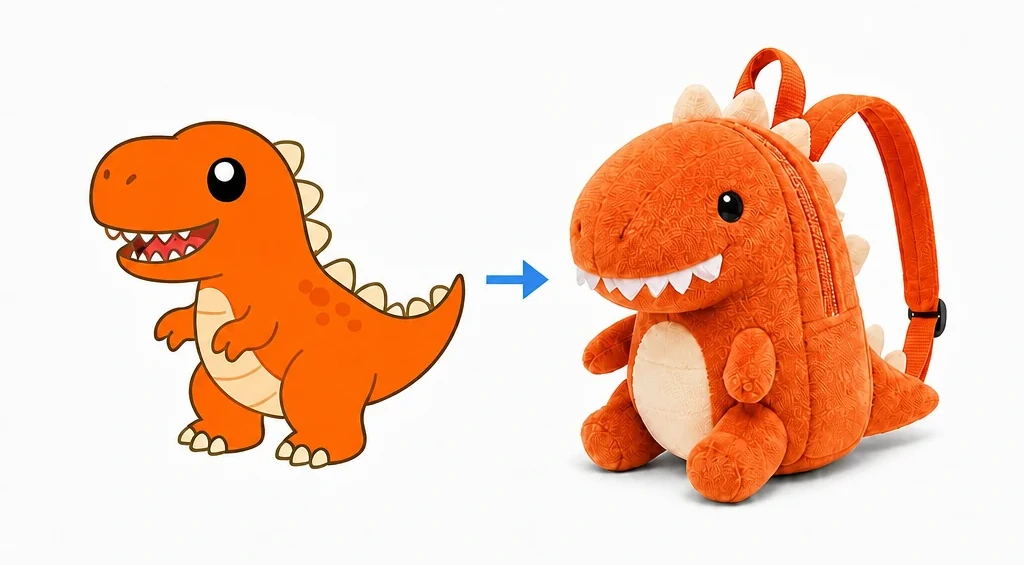
The drawing stands on two legs; the sample reads as a seated bag with the head projecting from the front. Visible on the sample: cream spikes down the back, a cream belly, white teeth, a vertical zip behind the head, a top carry loop and a shoulder strap with a visible adjuster, black on this sample. The pile carries a tone-on-tone surface pattern.
- Reference
- Orange dinosaur, design and sample
- Observed detail
- Seated bag form, vertical zip, cream spikes and belly, shoulder strap with a visible black adjuster
Red Monster
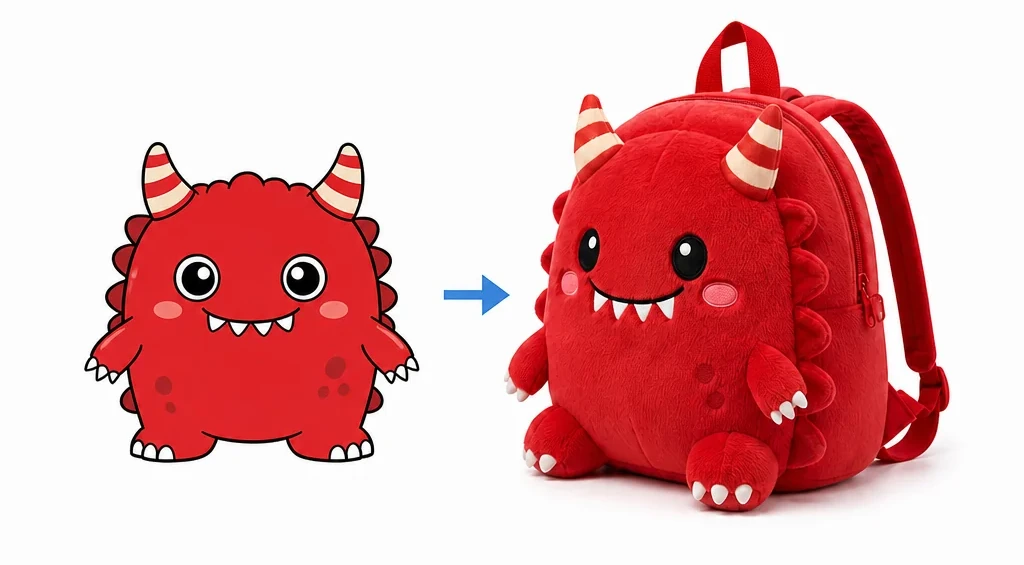
The drawing stands with its arms out; the sample reads as a rounded seated body with the head projecting from the front. Visible: striped horns, white teeth and claw details, pink cheek details, a ridge of spikes down the side seam, a zip across the top back with the slider at the side, a top loop and a shoulder strap with a visible adjuster.
- Reference
- Red monster, design and sample
- Observed detail
- Rounded seated body, striped horns, top-back zip, spike ridge, shoulder strap with a visible adjuster
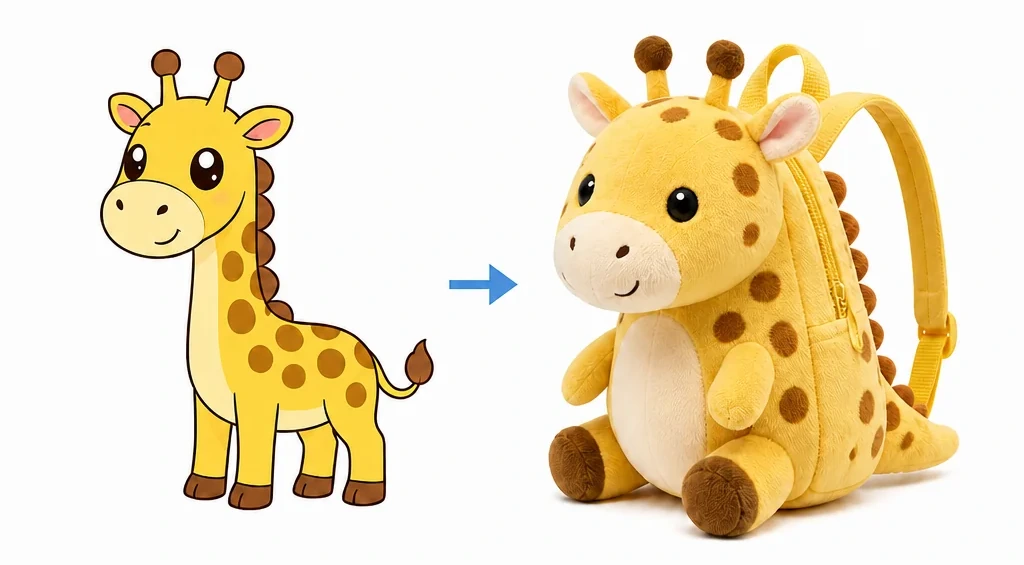
Yellow Giraffe
The drawing stands on long legs; the sample reads as a seated bag with the head projecting from the front. Visible: brown spots on yellow, a cream muzzle and belly, two knobbed ossicones, pink inner ears, a brown mane ridge down the back, a vertical zip at the side with a bright pull, a top loop and a shoulder strap with a visible adjuster.
- Reference
- Yellow giraffe, design and sample
- Observed detail
- Seated form, side zip with bright pull, spot pattern, mane ridge, shoulder strap with a visible adjuster
What Changes When A Plush Becomes A Bag
Read from the three pairs above.
| Decision Point | What To Confirm | Why It Matters |
|---|---|---|
| Form | Each drawing is a standing character; each sample reads as a seated bag with the head projecting from the front. | Treat the drawing as character reference rather than as the bag pattern. |
| Zip Route | Vertical behind the head on the dinosaur and the giraffe; across the top back on the monster. | The opening decides which panel carries the zip and where the pull ends up. |
| Strap And Hardware | A shoulder strap, a top carry loop and a visible adjuster on each strap; the dinosaur’s adjuster is black. Where the strap enters the body is hidden. | Attachment method, and therefore load behaviour, cannot be read from these photographs. |
| Inside | Lining, fill, panel layout, capacity and internal stitching are not visible in any of the three. | These are specified at sampling, not inferred from a photograph. |
Before You Ask For A Sample
Photographs show the finished piece, not the inside: lining, straps and closure construction has to be confirmed on the sample or in the brief rather than read from a picture.
- Proportion and size: state the finished height or length you need.
- Surface and craft: say whether the look depends on pile, print or embroidery.
- Build detail for this form: Plush Bag Customization.
Decisions Before A Bag Sample
Carry load, then shape, then surface.
Decide the load first. A child’s bag and a convention tote need different reinforcement even when they look alike.
Then decide whether the plush body is structural or decorative. A decorative plush front on a woven bag behaves very differently from a fully plush bag with a lining.
Surface last: long pile traps dirt on a bag in a way it does not on a shelf toy, which is a reason many bags use shorter pile on the base and straps.
Where This Connects
Category page and the process pages.
Load ratings and hardware specifications are agreed per project.
Bag Questions
Can Any Plush Shape Become A Backpack?
Feasibility depends on a usable opening, body volume, strap layout and intended use, so some shapes need adaptation. The three pairs below are the only shapes shown on this page.
Why Do The Drawings Stand While The Samples Look Seated?
That is what the three pairs show: standing artwork beside a seated-looking bag. Why the form changed for these builds is a sampling question, not something the photographs settle.
Where Is The Strap Fixed?
Not visible in these photographs. The strap disappears behind the body on each sample, so the anchoring method is a sampling decision rather than something this page can show.
Do The Photographs Prove A Load Rating?
No. Nothing on this page is a load rating, a capacity or a wash instruction. The photographs document the outside of three samples.
Can The Same Bags Be Made As A Cat, Dog Or Bear?
The three shown are a dinosaur, a monster and a giraffe. A different animal is a new pattern: the construction questions stay the same, but no cat, dog, bear, rabbit or bunny backpack is shown on this page.
Send The Load And The Shape
Those two decide reinforcement before artwork does.