Custom plush · Keychains & bag charms
Custom Plush Keychains & Bag Charms
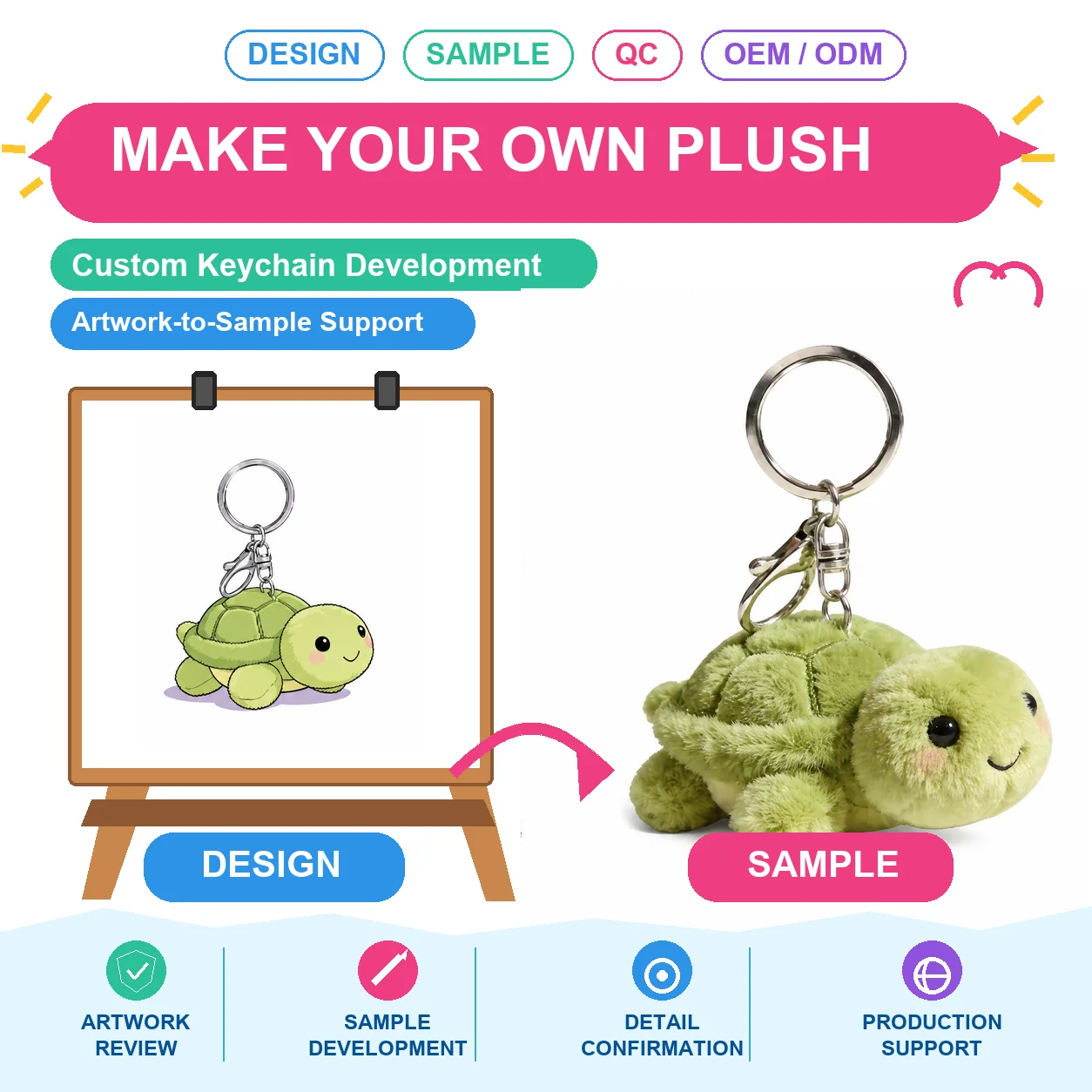
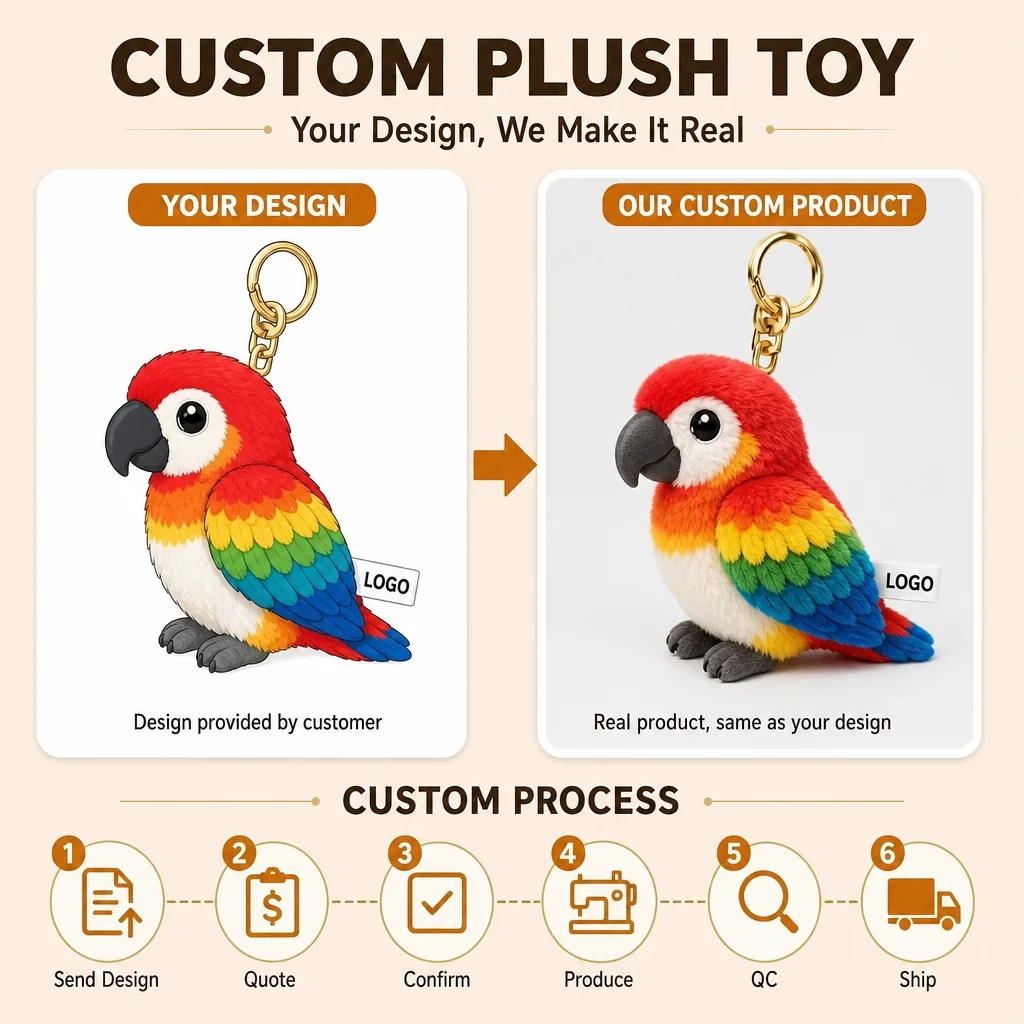
Orui Toys develops custom plush keychains and bag charms from your artwork or an approved sample. Decide how much detail survives at charm size, how the charm is attached, how the face and graphics are made, and how a series of styles and colours is planned. Share your design, the intended user and the market to begin.
What A Keychain, Keyring Or Bag Charm Has To Do
A plush keychain, keyring and bag charm are the same piece of work used three different ways. A keychain usually travels with keys or hangs from a zip, a bag charm is clipped to a bag and moved between them, and a charm on a longer loop is carried or worn as an accessory. How the charm is used decides the attachment, the weight it carries and the amount of movement it takes, so the use and the attachment need to be confirmed for each project rather than assumed from the drawing.
Orui Toys is Dongguan Orui Toys & Gifts Co., Ltd., an OEM/ODM plush manufacturer. The in-house project team coordinates pattern development, sampling and production for custom plush keychains and bag charms, and works with controlled partner workshops for embroidery, printing and part of the sewing. Charm and fitting assembly is coordinated with those controlled component suppliers, so the scope and the division of work are set out for the project rather than assumed.
Charm development therefore starts from the use, not only from the picture: what the charm hangs from, who uses it, how much movement it takes, and whether it will be sold as a retail accessory, a promotional item, an event souvenir or an adult collectible. That decision affects the material, the fitting and the test requirement, and it is agreed at the start of the project. A charm intended for young children is assessed on its own case.
How It Is Carried
On keys or a zip pull, clipped to a bag that changes daily, or worn on a long loop. The carry sets the attachment and how much movement the piece takes.
What It Hangs From
A split ring, a swivel hook, a ball chain or a braided loop. Each changes the drop, the opening and the angle the charm sits at.
Size, Depth And Weight
Depth and fill decide whether the charm hangs flat or holds its shape. The finished weight is measured on the sample, not calculated from the drawing.
Still choosing a style? Browse Plush Keychains & Bag Charms product references for shape and structure ideas, then bring the specification into the development discussion.
What To Send For A Keychain Or Bag Charm Brief
A charm brief is judged on the artwork, the finished size, the attachment and the intended user. Start with the drawing, reference or sample you already have and mark the points that are still open; a single front view can be assessed, but the pattern maker will then need to ask about what the drawing does not show.
Starting Points We Can Work From
- Hand drawing or concept artwork
- 2D views: front, side and back
- Reference photographs of a similar charm
- An existing pattern or a physical sample
- A complete tech pack
- A 3D file as an appearance reference
A 3D file is useful as an appearance reference only. It does not remove the need for pattern development: a charm is still built from measurable pattern pieces, so a separate pattern is developed for the small form and assessed as part of the project.
What The Brief Should Describe
- Front, side and back views, plus a close-up of the face or graphic
- Finished height, width and depth, and the proportion between them
- How the charm hangs: the attachment type and where it joins the plush (see attachment and hardware)
- Colour references as Pantone codes or physical colour cards
- Which parts are sewn, which are printed or embroidered and which are separate fittings
- Intended user and age group, sales market and any test requirement
- Quantity for each shape and colour, the required date and the destination
- The person who consolidates feedback
Say early whether the project is a single charm or a series. The number of shapes and colours changes both the pattern work and the material minimums.
Working At Charm Size: The Details That Change
A charm is not simply a large plush toy made smaller. As the finished size comes down, the number of visible seams, the size of the stitches, the thickness of the fabric and the number of separate parts all become design decisions rather than decoration. Detail that reads well on a 20 cm toy can turn into noise on a charm, so the drawing is simplified before the pattern is cut.
- Silhouette first: the outline carries recognition at small size. A distinctive shape survives better than fine surface detail.
- Fewer, larger features: eyes, nose and mouth need enough area to stay readable once they are stitched or printed.
- Seam and part count: every extra panel, limb or garment piece adds a seam and a chance for bulk to build up. Parts are consolidated instead of scaled down.
- Fabric and filling: a long pile can hide the silhouette and swallow small features; the pile length and the fill amount are chosen for the charm rather than borrowed from a larger product.
- One size, one pattern review: a different charm size is not a scaled copy. The pattern breaks, the fill and the small parts are re-checked, and the new size is sampled and approved on its own.
What To Send For A Charm-Sized Design
- The finished height, width and depth, not only one overall size
- The parts that must stay readable at that height: eyes, mouth, a logo or a graphic mark
- Any part that has to stay separate: an ear, a tail, a garment piece or the loop
- The intended carry, and any target weight if the charm is sold by weight or packed in bulk
- Colour references per part, so a small area is not matched from one overall colour
How The Reduction Is Confirmed
The simplified drawing is reviewed before the pattern is cut, and each simplification is listed so it can be approved rather than discovered at the sample.
The sample is then checked in the hand at the finished size: the outline at arm’s length, the face close up, the depth against the drawing, and the hanging angle with the fitting in place. Where a detail does not survive at that size, the choice comes back to you as a design decision.
Faces And Graphics On A Small Charm
On a charm the face is usually the part that has to work hardest, and it is where detail and small size conflict. Embroidery is the usual route for defined eyes, brows and small graphic marks, with stitch density and placement checked on the intended fabric. Printing applies surface colour and larger graphics to the fabric, and appliqué or panel construction gives a layered look with a slight relief instead of a flat surface. Which of these suits a given face is assessed for the project and confirmed on the sample.
Fine line work competes with pile direction and with the size of the charm itself. Where an illustration relies on hairline detail, the practical route is to simplify the linework and confirm on the sample that the character is still recognisable. Very dense or very fine work reaches its limit sooner on a small piece than on a larger one.
Choosing Between Them
- Embroidery for eyes, brows, mouths and small graphic marks that must hold a defined edge.
- Printing for surface colour areas and larger graphics where a flat application suits the fabric; the printable detail is discussed for the specific material and confirmed on a sample.
- Appliqué or panels where a layered look with slight relief is wanted and an extra seam is acceptable.
- Mixed methods where a printed colour area sits with an embroidered outline; the combination is checked on the sample for alignment.
The method for eyes, nose and any added feature is agreed per design, because a fitted plastic part or a metal fitting is a small-part decision as well as a visual one. If a project needs a specific expression, say so at the start and expect it to be confirmed on a physical sample rather than from a screen.
Attachment And Hardware: Rings, Hooks, Clasps And Clips
How the charm hangs is a design decision with a safety and a cost effect, so it is settled before sampling. The attachment is chosen with the finished weight, the way the charm will be used and the intended user in mind, not only with the look of the artwork.
| Attachment | Typical Use | Points To Agree |
|---|---|---|
| Split ring or keyring | Keys and zip pulls | Ring diameter, metal or coated finish, and how the ring joins the plush |
| Swivel hook or lobster clasp | Bag charms that are moved between bags | Opening force, closeness of the gate and whether the charm can detach in use |
| Chain with a small ring | Charms that need a longer drop | Chain length, link gauge and the point where the chain meets the fabric |
| Cord, loop or strap | Soft, lightweight charms | Loop length and width, because a long cord or neck strap changes the review |
| Plastic clip or karabiner | Promotional and event charms | Whether a suitable part is available for the design, and the material, colour and edge finish of the part |
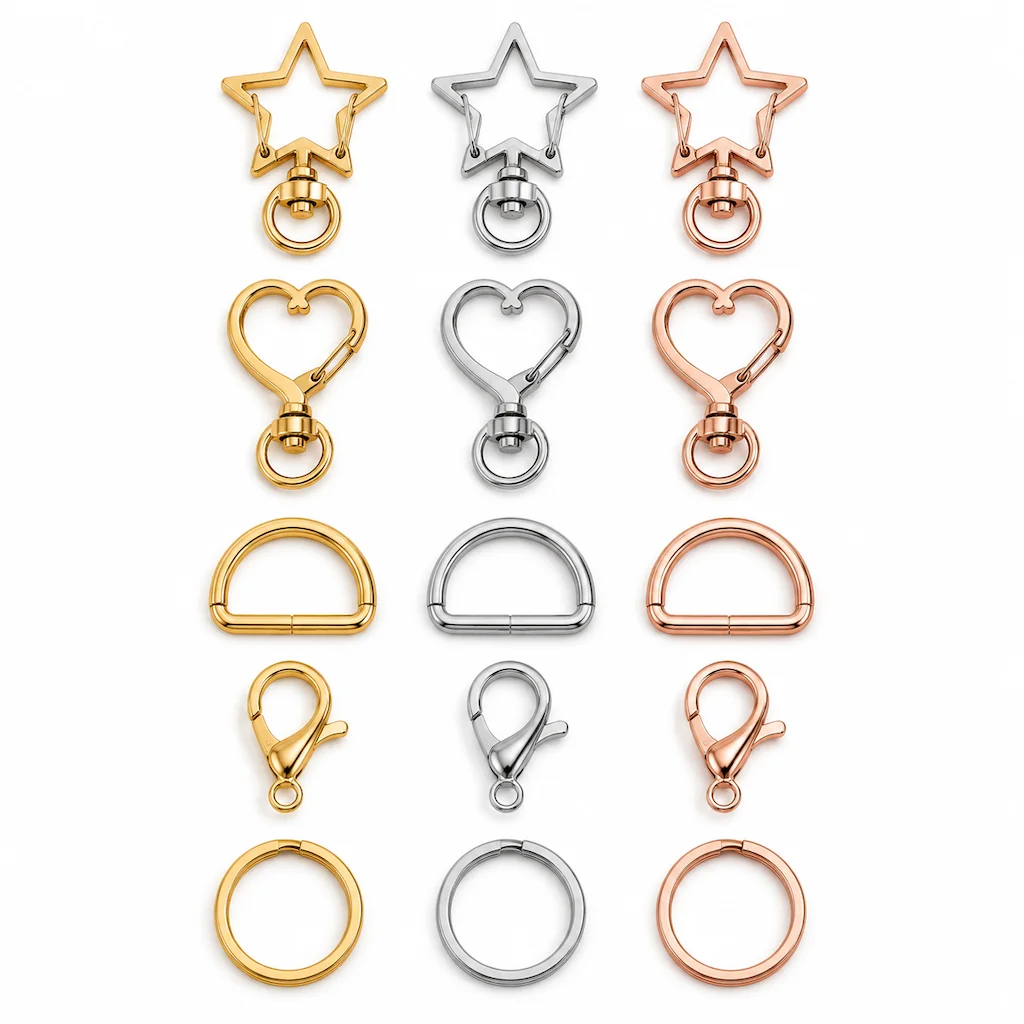
Split Ring, Swivel Hook Or Lobster Clasp
Typical use: keys, zip pulls, and a bag charm that is moved between bags.
Agree: ring diameter, finish and colour, the gate opening, and where the fitting joins the plush.
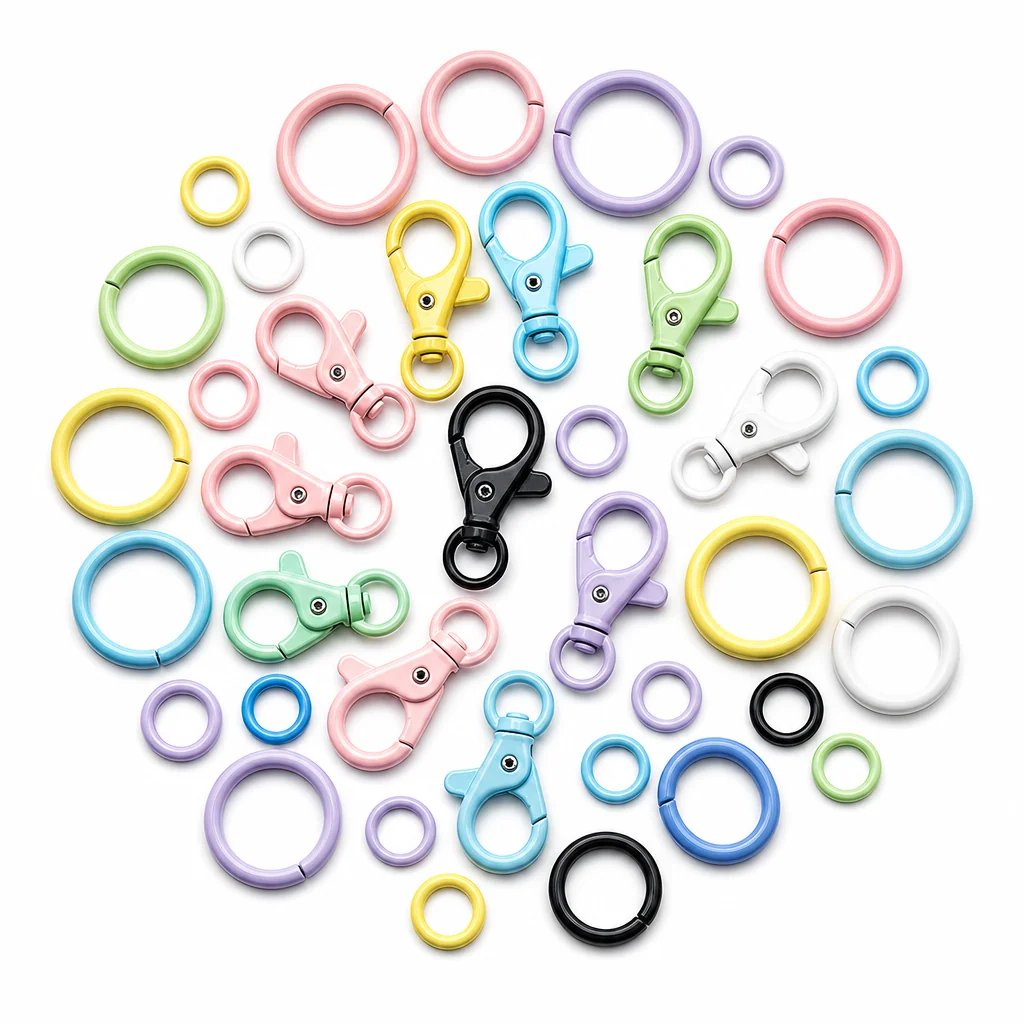
Plastic Clip Or Karabiner
Typical use: promotional and event charms, where a lighter part suits the price and the user.
Agree: the gate opening, the edge finish, the colour against the artwork, and whether a plastic part suits the age review.
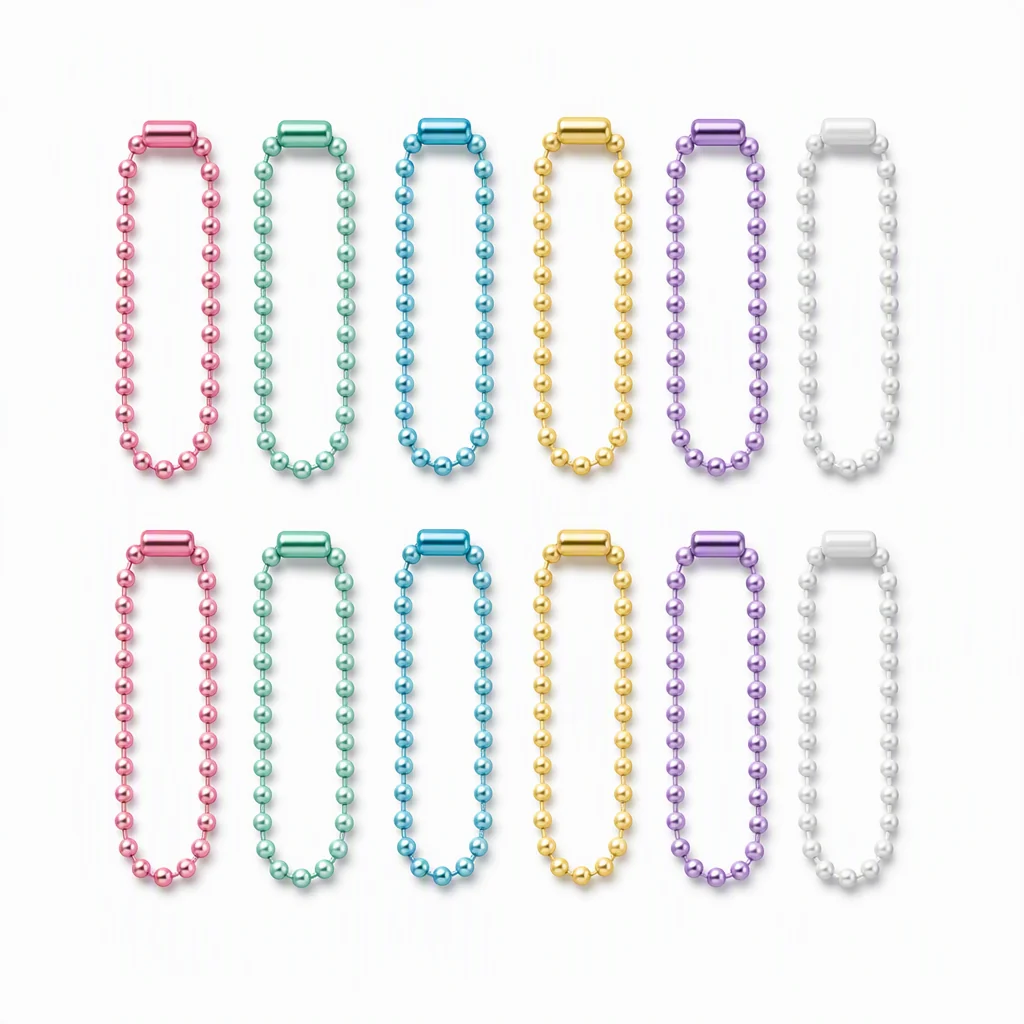
Ball Chain Connector
Typical use: a light charm that should hang at one length without a long strap.
Agree: chain length, connector type and colour, and how the connector joins the loop on the charm.
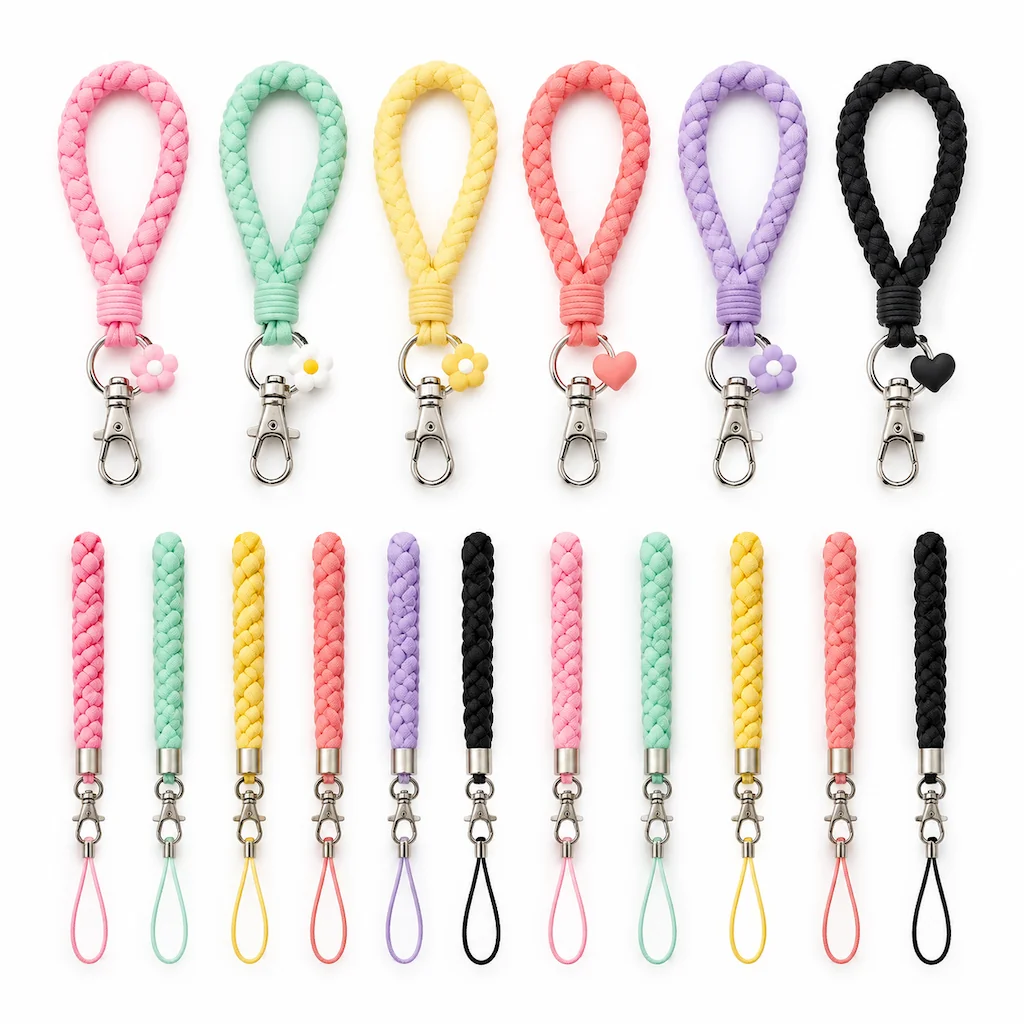
Braided Loop Or Strap
Typical use: a charm worn on a wrist or bag strap, where the loop is part of the look.
Agree: loop length and width, the clasp type, and whether the extra length changes the review for the intended user.
The four photographs are component appearance references. They show the shape, colour and finish of parts that can be discussed for a project; they do not show the join into a plush, the strength of a fitting or a test result. The join, the hanging angle and the pull behaviour are confirmed on the sample for your project.
How The Fitting Joins The Plush
The fitting can be sewn into a top seam, threaded through a reinforced fabric tab, or joined through a small separately made part that is then attached to the body. Which route suits a given design is assessed for the project and confirmed on the sample: the pattern is set so the charm hangs straight, the join sits where the body can support it, and the fabric around the anchor does not pull out of shape.
What Is Reviewed
- Small parts that could detach, including the fitting itself
- Sharp edges or burrs on the metal or plastic parts used for the fitting
- Plating condition, tarnish and colour difference between batches
- Small-part and age considerations for the intended market
- Whether the charm is meant for keys, a bag or a child
What Is Agreed About The Fitting, And What Is Confirmed Per Project
It is worth being precise here. Charm and fitting assembly is handled with controlled partner workshops and component suppliers, and the project team coordinates the specification and the approval. Because a charm is a small item with a fitting, pull behaviour, small parts, edge and plating condition all need to be reviewed against the age and the market requirement of the project.
Decide with the project team what the fitting needs to demonstrate for your case, and how it will be checked. Where a measured result is required, the test method, the equipment used, the number of pieces checked and the acceptance values are agreed with the laboratory or the standard that applies, and written into the project specification before the run.
Treat any material, colour or fitting substitution as a change to the approved specification: it should be put to you with its effect on appearance, cost and schedule, and approved in writing before it is used, rather than changed quietly in production. If the fitting or its material changes after approval, confirm whether the strength check or the applicable test position needs to be repeated.
Third-party testing can be arranged for the product, the intended age and the destination market. Which laboratory is used, which products and markets it covers, and the scope and validity of the resulting report are confirmed for the project. See Quality & Safety for the wider topic.
Colours, Materials And Planning A Series
Charms suit a series: several characters, one shape in a range of colours, a set of animal-shaped charms, or one character in a set of outfits. Mini plush charms made as a matched set are often the smallest item in a range, so the same questions come up for each piece in it. A series also multiplies the work, because each shape introduces its own pattern and each colour introduces its own material minimum. The useful planning question is how much of the series can share fabric, thread and process.
- Colour references: Pantone codes or physical colour cards. Screen colour is a reference only, and a colour is confirmed against a physical card or a sample.
- Fabric and pile: the fabric, pile length and fill are chosen so the silhouette reads at charm size. Changes to any of them are a specification change.
- Per style and per colour: each style and colour is assessed on its own pattern, material minimum and packaging. Splitting styles or colours affects sampling, material purchasing and the quotation for each part; there is no separate minimum beyond the 1-piece product minimum.
- Shared process: styles that use the same fabric, thread and print method are easier to organise together, which is where a series saves effort.
- Management cost: the more styles and colours in the set, the more pattern versions, material lots and packing decisions have to be tracked and kept consistent.
Material options are covered in more depth on Materials & Customization Options. Regular plush fabric, filling, sewing, embroidery, printing, cutting and laser cutting support charm development; custom-colour fabric, unusual hardware or an electronic part is sourced and validated for that project rather than treated as a standard stock item.
Approving A Small Charm Sample
A charm sample is judged on more than one photograph, because shape, size, colour, face detail and the attachment can each go wrong on their own. These are the checks worth agreeing with the project team for your charm, together with the record that decides which version goes into production.
- Check 1
Silhouette And Face
Look at the outline at the finished size and the face close up. Confirm the shape still reads at arm’s length, and that the eyes, mouth and any graphic mark sit where the agreed drawing puts them.
- Check 2
Connection And Hanging
Check the fitting type, the opening, the join into the plush and the angle the charm hangs at. Confirm it hangs straight and that the join sits where the body can support it.
- Check 3
Stitching And Filling
Check the seam lines, the closing seam and the amount of fill. Confirm whether the charm holds its shape or sits flat, and that no seam pulls, gapes or gathers the face.
- Check 4
Branding And Packaging
Check the label, barcode, hang tag, bag and carton marking. Confirm the correct version for each style and colour, because a small charm is easy to mix up in a bulk pack.
Evidence For Each Check
- Shape and face: multi-angle photographs, a 360° video or a video call, with the face shown close up.
- Size: ruler photographs and a measured size table against the agreed dimensions.
- Colour and fabric: physical material cards and Pantone references, compared against the agreed standard.
- The fitting: the attachment opening and the join into the plush, checked on the sample rather than on the drawing.
What To Record And Confirm
Ask for comments to be consolidated into one dated response per sample version, and keep a correction against the agreed brief separate from a new design, size or material request. Identify the approved physical sample with a version and a date, and confirm with the project team that this is the article the run will be checked against. If the fabric, structure, fitting or packaging changes afterwards, confirm whether a revised sample and a renewed approval are needed before production.
Orui coordinates pattern and sample development with the project team and partner workshops. Confirm the responsibilities, the version and the approval route for your project.
These are checks to agree for your project, not a statement that a test has been passed. Where a measured result is required, the method, the equipment, the number of pieces checked and the acceptance values are agreed with the laboratory or the standard that applies, and written into the project specification before the run.
Packaging And Inspection For Small Plush Charms
Packaging and inspection are agreed per project rather than taken from a standard list, because a charm is small, easy to mix up by style or colour, and often packed in bulk.
Packaging
- Individual PE or OPP bag, label and barcode
- Inner box, colour box, display box or gift box
- Master carton and carton markings
- Vacuum packing where it suits the product
Vacuum packing is available as a process. It is not applied automatically to every charm: a rigid fitting or a structured shape can be left marked or distorted, so a project that uses it is checked after unpacking before the method is confirmed. For products intended for children, bag thickness, air holes, warnings and age marking follow the destination market requirements.
Inspection
- Incoming material and component checks against the approved specification
- First-article check against the approved sample before the run continues
- In-process checks at the steps that matter for the project, including the face and the fitting
- Finished-goods check covering the correct style, colour, fitting, label and packaging version
Ask for the inspection points, the sampling rule, the defect grading and the release authority to be written into the inspection specification for your order, and confirm them with the project team before production. Where a result differs from the approved sample, the affected pieces should be set aside and decided with the project team before the batch continues, with the batch, the quantity, photographs and the agreed outcome kept as the record.
For planning, treat a run as able to start once the approved sample, the confirmed order, the agreed deposit, the frozen materials, packaging and label data, and the agreed test plan are all in place; confirm that start point with the project team for your order. No single lead time applies to every charm project, so timing is confirmed for the specification rather than quoted from a table.
Your Artwork And Confidentiality
Before sending unreleased artwork, agree the confidentiality terms, the people who may see the files, and any restriction on photographs or sample display. What follows is what that agreement needs to cover; the wording is confirmed in the document itself for your project.
- NDA: an NDA needs to be agreed for the project with the contracting party – Dongguan Orui Toys & Gifts Co., Ltd. or the entity named in your order. The signatory, the definition of confidential material, the permitted recipients, the term and the exceptions are set out in the document itself, and a customer template can be reviewed. Confirm the signatory and the terms for your project, and raise any point that conflicts with the order contract before signing.
- Rights in the design: the buyer should hold the rights to the characters, logos and artwork sent for development, or hold documented permission to use them. Ownership of the design, and the permitted use of the patterns and other development files, need to be defined in the project contract rather than assumed here.
- Display and reference: whether a project may be shown, and in what form, needs to be agreed separately and in writing. Ask for the display and confidentiality terms to be recorded before samples, photographs or the project name are used anywhere.
- Lawful basis: a charm may carry a character, brand or logo only where the project has a lawful basis. Where a project involves a recognisable brand, character, film, game, sport or celebrity image, be ready to provide the authorisation or the licence scope, or another verifiable source of rights, for the project team to confirm. Removing or imitating another brand’s markings is not a substitute for that permission.
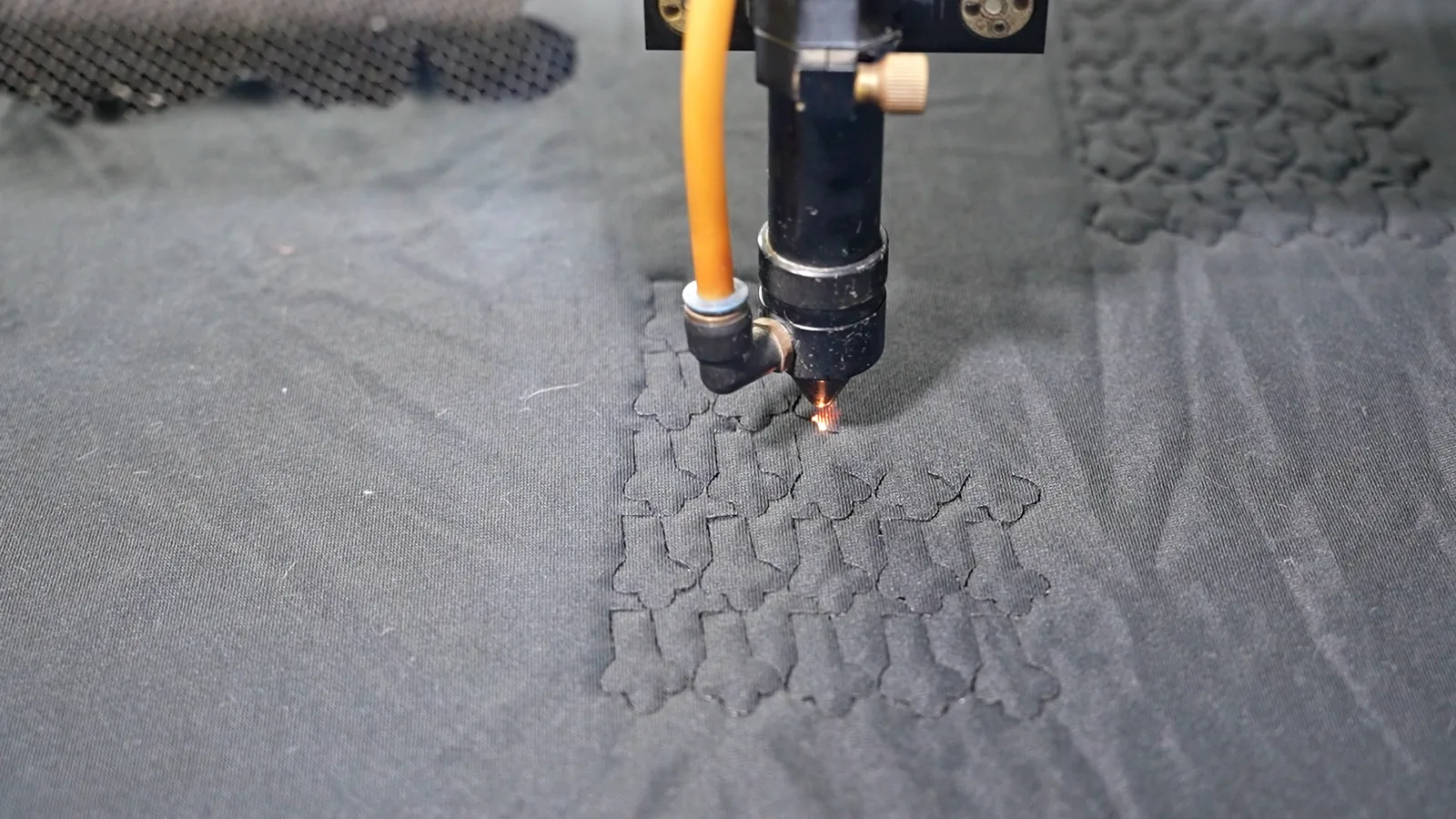
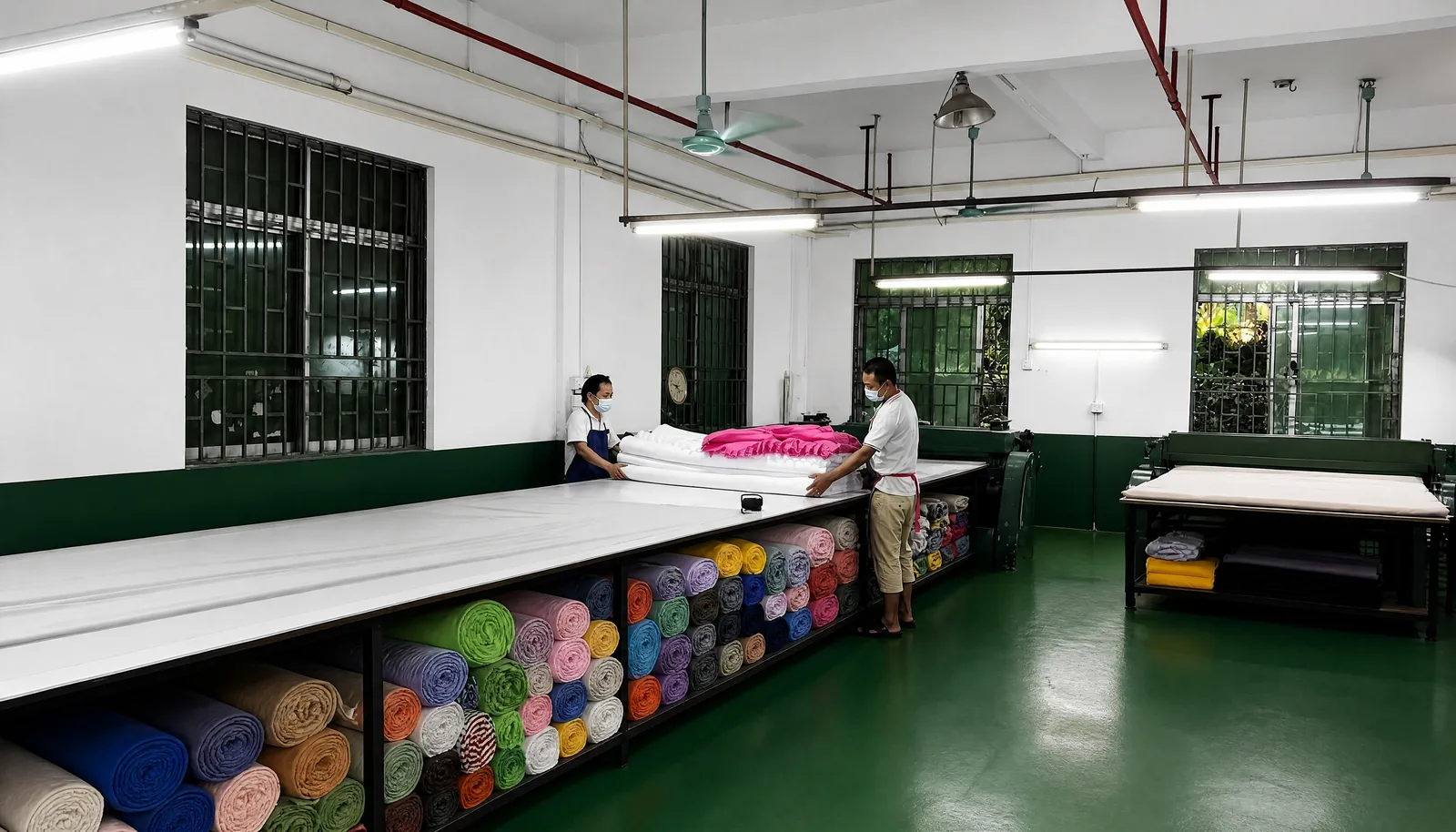
For character, anime and game projects that need a fuller discussion of the rights position, see Custom Anime & Game Plush. The photographs on this page illustrate production and process, and should not be read as a client case, a licence or a record of a delivered order.
Custom Plush Keychain Questions
Is There One Minimum Order For Plush Keychains?
Custom orders start from 1 piece, and there is no ready stock; a single piece also goes through sampling or production, with cost and lead time confirmed for the project. Cost and lead time are quoted for the project.
Can The Same Charm Be Produced In More Than One Size?
Yes, where the pattern allows it. A different size is not a scaled copy: the proportions, pattern breaks, fill amount and small parts are re-checked, and the new size is sampled and approved on its own before it goes into a run.
Can You Match A Photograph Of A Charm I Like?
A photograph is a useful reference for shape, proportion and finish, and the design can be developed from it. Where the photograph shows a protected character or brand, a lawful basis for the project is required before development continues. The finished charm is built from a new pattern rather than copied from the image.
How Is The Attachment Chosen?
The attachment is selected with the finished weight, the way the charm is used and the intended user, then confirmed on the sample. A rigid fitting on a light charm, or a long cord, changes the review, so the type and the length are agreed at the start rather than assumed from the artwork.
Can The Charm Be Made To Hang Facing One Way?
A fixed loop can reduce rotation, but it does not guarantee which way the charm faces. The final orientation depends on where the attachment sits on the body, how the weight is distributed and how the charm moves when it is carried, so say which side has to face out when the charm is worn or displayed. The hanging position is checked on the sample with the fitting in place.
The Artwork Has Detail That Will Not Survive At Charm Size. Who Decides What Is Simplified?
The project team lists the simplifications with their effect on how the character reads, and you approve them before the pattern is cut. Nothing is simplified silently between the drawing and the sample: a change to the agreed design is put to you as a decision, not made in production.
What About Testing For My Market?
Agree the testing requirement for the product, the intended age and the sales market. Orui can arrange third-party testing, and the applicable requirements, the laboratory used, the cost and the report scope are confirmed for your project. A report applies only to the products and materials it covers.
Discuss This Product
Send your charm artwork or sample, the attachment you have in mind, the intended user and the target market. We will confirm what is needed for the first feasibility assessment and the sample plan.
Use Request a Quote to review the project details and prepare your brief. For current enquiries, email landy@oruitoys.com with your project brief.