Custom Character & Mascot Plush
From character artwork to a production-ready plush sample
Orui Toys develops custom character plush and custom mascot plush for brands, IP holders, corporate mascot projects and independent creators. Start with artwork, a concept or a physical sample. We assess the proportions, face, materials and construction before sample development and a proposed bulk order.
We are an OEM/ODM plush manufacturer with an integrated supply chain. Our team coordinates requirement assessment, pattern and sample development, purchasing, production planning, quality control and delivery. Embroidery, printing and part of the sewing are completed by partner workshops under Orui’s coordination and inspection. Our core team brings 15+ years of plush manufacturing experience; the company was established and began exporting in 2018.
Prefer email? landy@oruitoys.com
What We Can Start From
A custom plush mascot rarely arrives as a print-ready file, and a set of custom mascot plush toys may start from nothing more than a sketch. We accept the inputs below, and we will tell you early if something is missing rather than guessing at the structure later.
- Hand drawing or concept sketch – useful for direction and character read; we will ask follow-up questions about anything hidden behind the front view.
- 2D character views – front, side and back views are the most useful single input for a character plush.
- Brand or IP visual guidelines – colour references, proportions and any elements that must stay recognisable.
- Reference photos – for texture, pose or an existing object the character is based on.
- A physical sample – if you already have a plush or a prototype, we can work from the physical item.
- A full tech pack – dimensions, materials, construction notes and tolerances.
We also accept 3D files, but treat them as an appearance reference only: a plush is built from flat pattern pieces sewn into a three-dimensional shape, so a 3D model still has to be converted into a sewn pattern. That conversion is a separate engineering step, not an export.
From Artwork To A Sewn Pattern
The work between your artwork and a first sample is mostly about deciding what the character must keep and what it can lose. A drawing can show detail that no sewn shape reproduces at the same scale, so we translate it rather than trace it.
What The Brief Needs To Describe
- Silhouette and proportion – total height, width and depth, plus head-to-body ratio. These decide how the plush sits and reads from across a room.
- Key identity features – the two or three elements that make the character recognisable. Protecting these is usually worth more than protecting surface detail.
- Views – front, side and back at minimum; top, bottom, ear or tail shape, hand and foot shape, and the pose (standing or sitting) if it matters.
- Face layout – eye position and size, muzzle or snout shape, mouth, brows and any markings that cross the seam lines.
- Attachments – how a bag, hood, tail or accessory connects to the body.
How The Pattern Is Developed
Pattern development is coordinated within our Dongguan Chashan production system, including partner pattern makers. Discuss the required shape, dimensions and essential character features before the pattern is developed.
For a clear development record, agree a project reference, pattern version, size table and first-sample review notes. Record the version approved for production so that a later sketch or chat message cannot be mistaken for an approved change.
Orui selects partner workshops, confirms samples, coordinates schedules and inspects incoming, in-process and finished work. Orui remains responsible for the goods it delivers, including work coordinated through partner workshops.
Animal Mascot
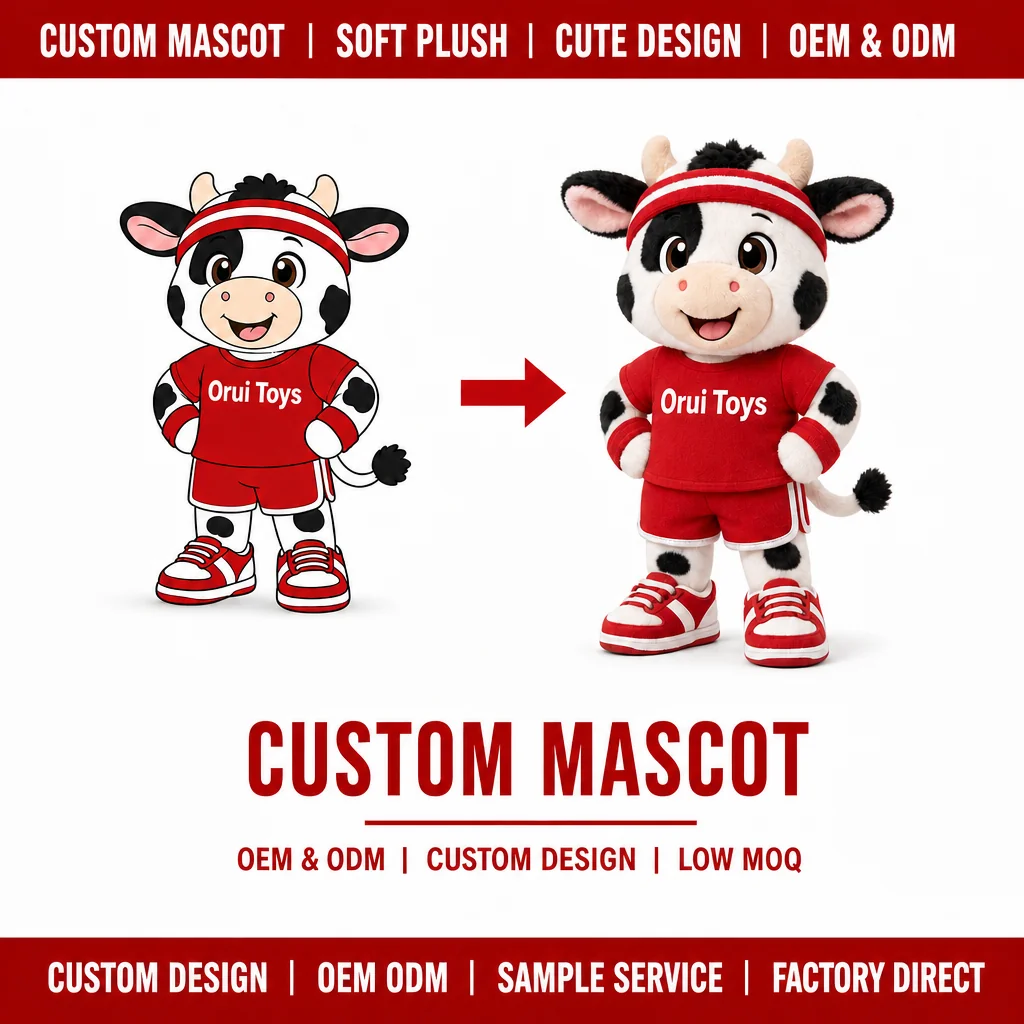
A cow character in a red outfit shows how contrasting patches, a cap and clothing can help distinguish a mascot. Identify which features must remain recognisable in your own sample.
Woodland Character
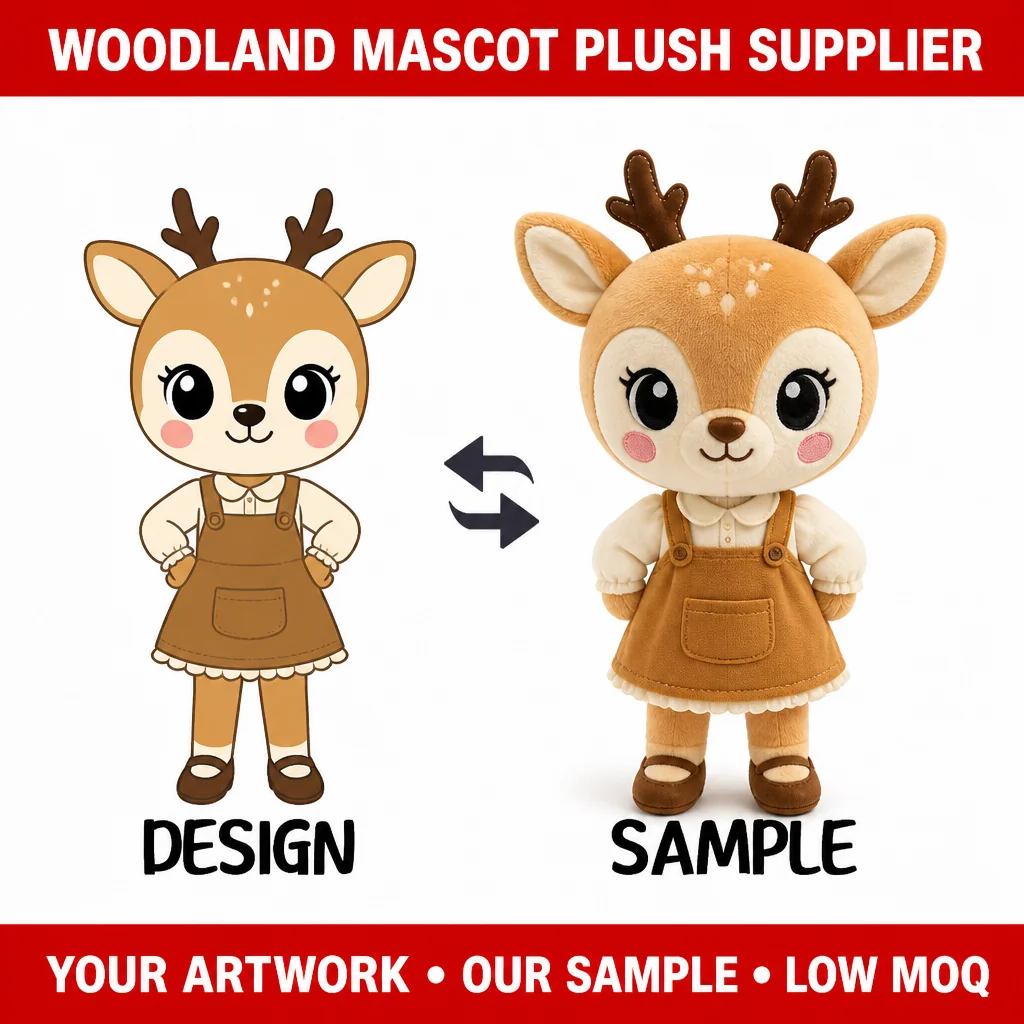
Compare the antlers, ears, face markings and brown dress in the reference image. For your project, discuss which shapes need separate pieces and which can be represented as surface details.
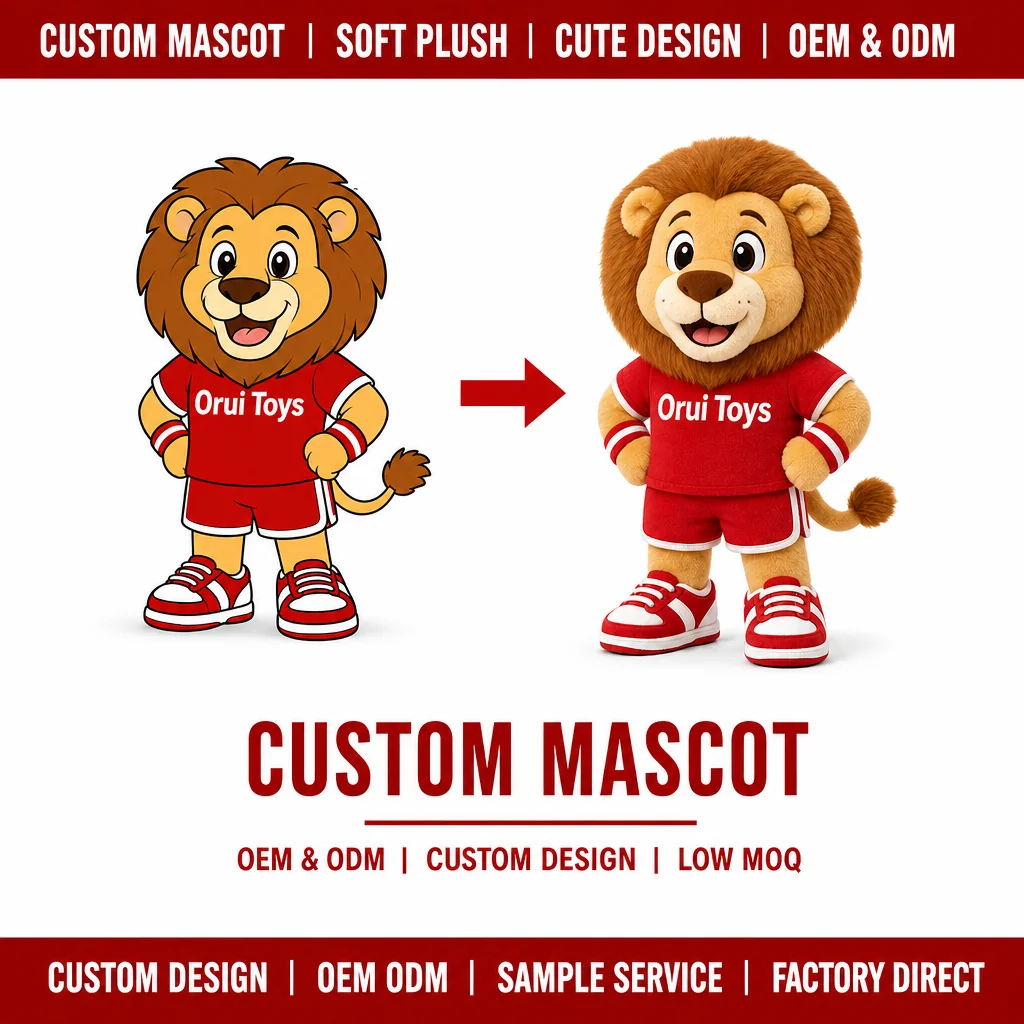
Lion Mascot
The mane, face shape and red outfit give this lion a clear identity. Use your sample review to compare these visible features from the front and side.
These images are design-and-sample references for discussing shape, colour and construction. They do not identify customer projects or establish ownership of the illustrated characters.
What Each Choice Changes
| Choice | Options To Settle | What It Changes In Sampling And Quote |
|---|---|---|
| Structure | Single figure; plush head on a soft body; seated or standing | Pattern piece count and whether a joint or wire is needed; more pieces means more seams to align in the sample |
| Size | Finished height and body-to-head ratio | Fabric consumption per unit and whether the face stays legible at that scale |
| Surface | Short pile, long pile or mixed | Pile direction changes how the face is cut and how embroidery sits on the surface |
| Craft | Face embroidery or print; fixed or separate outfit | Embroidery files and outfit patterns are sample-round items; each adds a separate approval |
Face Construction And Detail Trade-Offs
Most of the recognisability of a character plush sits in the face. The face is also where the hardest trade-offs are, because detail, head shape and safety pull against each other.
| Technique | What It Is Good At | What To Watch For |
|---|---|---|
| Embroidery | Eyes, brows, mouths, small markings and line work; sharp, repeatable edges on curved surfaces. | Dense or large fills add weight and stiffen the face. Very fine line work has a minimum readable width. |
| Screen Printing | Flat colour blocks and larger graphics; light on the fabric and keeps the face soft. | Best on flatter panels; artwork must be separated into colours, and pile texture softens fine detail. Other printing methods are assessed per project. |
| Appliqué And Patchwork | Building shapes from separate sewn pieces – muzzles, ear interiors, patches and costume panels. | Each piece adds a seam and a small thickness step; too many layers distort the silhouette. |
| Laser-Cut Detail | Precise cut shapes and consistent outline pieces across a run. | Some fabrics need checking for edge scorching, smell or colour change before it is approved for production. |
In practice the trade-off is decided in this order: keep the silhouette and the two or three features that identify the character, then spend the remaining budget on detail. Where a feature cannot survive as sewn detail, we will say so and propose an alternative rather than delivering something that quietly loses the character.
Small attached parts – plastic eyes and noses, keyring hardware, trims – are treated as a risk item and reviewed against the target age and market before the sample is approved.
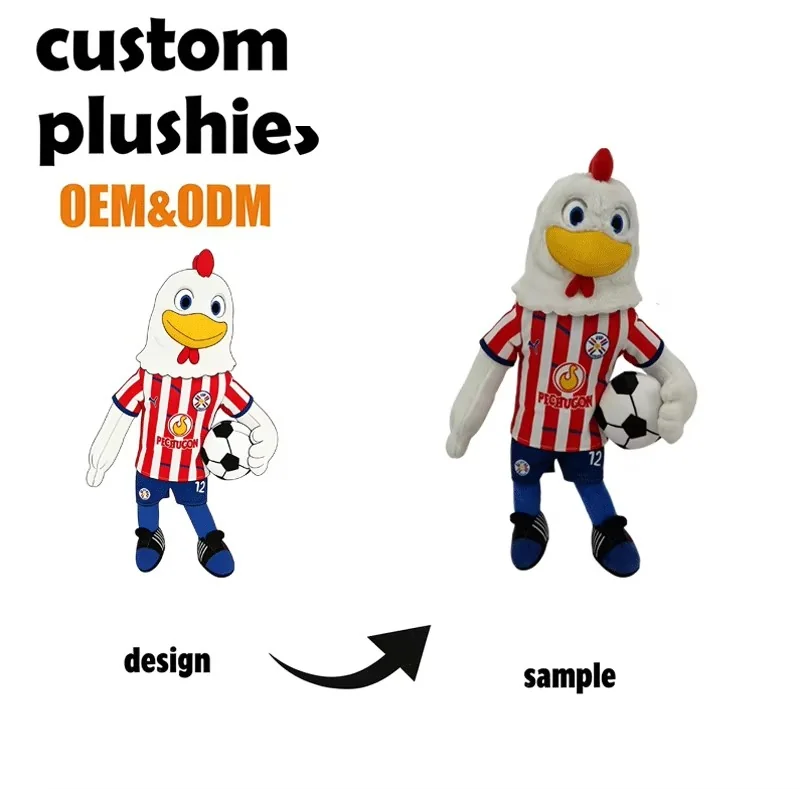
Character With Costume
A red-and-white sports outfit helps communicate the character’s theme. Confirm garment colours, fit and attachment details rather than relying on the front-view artwork alone.
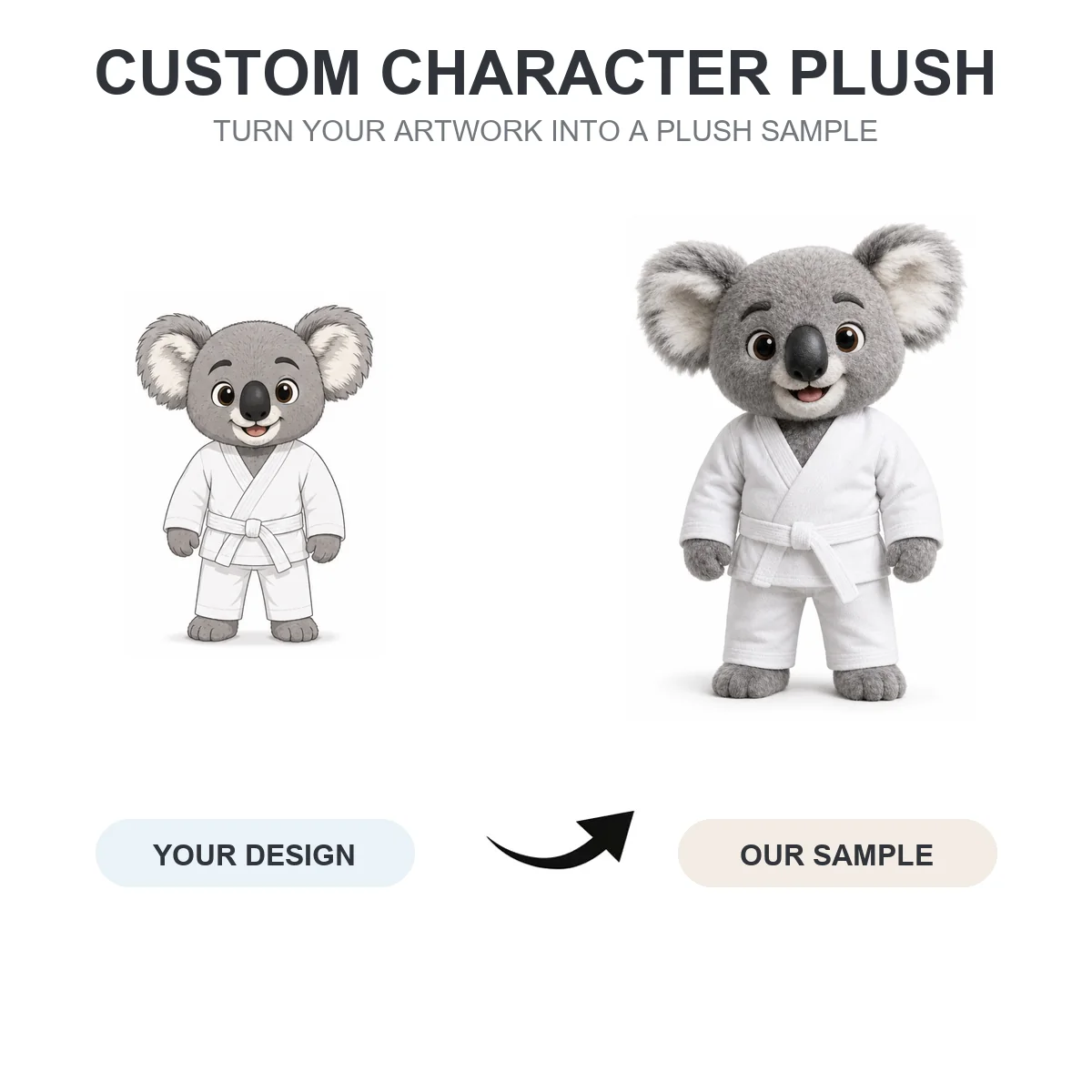
Character In Clothing
The koala is shown in a white uniform with a belt. For your own character, specify whether clothing should be fixed or removable and review the fit on the physical sample.
Clothing, Accessories, Colour And Materials
Costume, attachments and colour are where a character mascot usually becomes a real project, because each of them adds a decision that has to be settled before the sample is built. The same decisions apply whether the brief covers one mascot or a series of custom plush mascots built on a shared body.
Costume And Attachments
- Fixed detail – shapes sewn into the body: ear interiors, patches, tails, tufts and built-in costume panels.
- Removable clothing – garments that come off. These need their own pattern and a fit check, and they raise the question of small parts on a child-directed product.
- Accessories – bags, hats, scarves, tools or props. We will confirm attachments, tolerances and how the piece stays attached in use.
- Hardware – keyring hardware, clips and decorative metal or plastic parts. These are treated as risk items and reviewed against the target market.
Colour And Materials
Screen colour is a reference, not a specification. Fabric colour, pile length and surface texture are confirmed with physical material cards and Pantone references, because a colour that matches on screen and a colour that matches on pile fabric are two different problems.
Pile direction is part of the design decision as well: it changes how light falls across the character and where shading appears on a curved head or muzzle.
Fabric and filling purchasing is handled by a mix of our own purchasing and partner supply. A colour-specific fabric usually depends on the mill minimum for that colour, which is why a colour change can affect quantity and schedule even when nothing else changes.
Reviewing The Sample And Recording Revisions
Review a character plush sample against the agreed artwork and specifications. The checklist below helps you compare shape, expression, dimensions, material and hand feel; confirm the review methods and approval record for your project.
- Shape and expression – multi-angle photographs, a 360° video, or a video call where you see the sample in the round.
- Dimensions – photographs against a measuring tape together with a sample size table, so total height, width, depth and key feature sizes are on record.
- Fabric, pile length and colour – physical material cards and Pantone references. Screen colour is treated as indicative only.
- Filling and hand feel – use a physical sample; agree whether fill-weight records or reference samples are needed to make later comparisons clearer.
Before production, agree how approval will be recorded: a signed sample, an email or an approved version file. Include the version and date so that both teams can identify the same reference.
How Revision Comments Are Recorded
Consolidate each revision round into one set of comments, linked to the sample version and marked-up views. Separate corrections to the agreed brief from changes to the requirement so that the scope, cost and schedule can be reviewed clearly:
- Corrections to the agreed brief – identify where the sample differs from the confirmed design or needs a construction adjustment, and agree the corrective work.
- Changes to the design, size, material or function – identify the new requirement and confirm its effect on sample work, cost and timing before the next revision.
Sample fees, sampling time and included revision rounds depend on the project. Confirm them in the sample quotation, together with any special components, testing and sample delivery, before sample work starts.
What Bulk Consistency Means Here
Before bulk production, agree which approved piece will serve as the Golden Sample, with its project reference, version and approval date recorded. If materials, structure, packaging or process change, confirm whether a new Pre-production Sample is needed. Specify how production and final checks will use the approved reference.
It is worth being precise about what that does and does not mean:
- A plush character is assembled by hand. Consistency is controlled through the frozen approved version, the bill of materials and inspection records – not by promising that every piece is identical to the last.
- Tolerances depend on product size, the elasticity of the material, hand assembly and the customer’s own standard, so they are set per product rather than applied uniformly to everything we make.
- If a dimension, colour, expression or accessory falls outside the agreed tolerance, assess its effect on character recognition, safety and function. Agree the handling of affected pieces and any re-check before shipment.
- Agree the inspection scope, sampling rules and acceptance criteria for the project. These should state what is checked and how deviations are handled, without implying identical hand-made pieces.
If you are developing a custom OC plush of your own character, tell us the quantity and the timeline you are working to. The same applies to a small run of custom OC plushies or custom character plushies for a launch, or a production order of custom mascot stuffed animals for a programme: the development route and what we can quote depend on quantity and timing, and we confirm both per project rather than assuming a bulk programme. At smaller quantities we will also say plainly if a design detail cannot be reproduced at that run size.
Character Plush Project Brief Checklist
The more of this you can send with your first message, the faster we can come back with a development route instead of a list of questions.
- Rights statement: you own the character, or you hold a licence for it
- Artwork, concept or physical sample
- Front, side and back views
- Target height, width and depth
- Key features that must stay recognisable
- Target market and country of sale
- Intended age group and use
- Order quantity you are planning
- Target launch or delivery date
- Fabric, pile and colour preferences
- Filling preference and hand feel
- Costume, accessory and hardware details
- Labels, packaging and barcodes
- Testing or documentation requirements
On rights: please tell us at the start whether the character is yours or licensed. Projects that plainly involve an existing brand, anime, game, film or celebrity property need a licence or a verifiable rights source before we can quote – we will not copy a protected character without one, and customer artwork is never displayed publicly or put into production before that is settled.
Share the intended age group, sales market and any testing or documentation requirements at project start. Applicable testing can be coordinated with recognised third-party laboratories according to the product and market. The design, materials and intended use determine the requirements and report scope; documents can be shared only within their verified scope and permitted use.
Find The Right Next Step
For original characters, mascots and original-character (OC) projects, use the design-to-sample guidance above to plan the face, costume, sample approval and bulk requirements. This covers custom stuffed animals and mascots developed from your own brief.
For anime or game character projects, see Custom Anime & Game Plush. For a wider IP or creator merchandise project, explore Plush Merchandise for Brands & Creators.
Whole corporate or event programmes – a mascot rollout, a campaign run or a multi-item gifting programme – are planned as projects rather than as a single product, on Corporate & Promotional Plush.
If you already have a finished design and simply want to see the product range first, start from Character & Mascot Plush products, or read Design to Sample for the full development sequence.
Exploring a different product shape? View our custom plush capabilities for other development options.
Custom Character And Mascot Plush FAQs
Can You Work From A Single Front View?
Yes, we can start the assessment from one front view, but you should expect questions about the parts the drawing does not show: head depth, ear and tail shape, how the piece should sit, and how accessories attach. Those answers affect the pattern, so the earlier we have them the less the sample has to change later. Front, side and back views plus a small number of key dimensions give the most reliable starting point.
Can You Make Just One Piece?
Custom orders start from 1 piece, with no ready stock; a single piece still goes through sampling or production, and cost and lead time are confirmed for the project., with no ready stock; a single piece still goes through sample development or production, and cost and timing are confirmed for the project. A development sample is different from a one-off personal gift order. Share your planned quantity, design and timing so we can confirm whether the project fits; Custom orders start from 1 piece, with no ready stock; a single piece still goes through sampling or production, and cost and lead time are confirmed for the project., and there is no ready stock; a single piece also goes through sampling or production, with cost and lead time confirmed for the project.
Do You Sign An Nda?
If your artwork is confidential, raise the NDA requirement before sharing detailed files. Send your proposed agreement or ask to discuss terms with Orui Toys. Confirm the contracting entity, permitted use of files, disclosure restrictions and approval of the agreement before exchanging confidential material.
Can You Match A Pantone Colour, And Will Bulk Match The Sample Exactly?
We work from physical material cards and Pantone references, and colour is confirmed against a physical standard rather than a screen. Bulk will be produced to the approved reference, but because plush is made from dyed pile fabric that is cut and assembled by hand, batch-to-batch variation is a real variable and is handled through the material approval and inspection process rather than described as an identical match. That is why approving a physical sample matters more than approving a colour on screen.
Discuss This Product
Send the artwork or sample you have, the quantity you are planning and the market you are selling into. If something important is missing we will tell you what we need instead of quoting around it.
Or email landy@oruitoys.com. Based in Chashan, Dongguan, Guangdong, China.
You can email your project brief to Landy and attach reference files. The Request a Quote page is still being prepared in this draft site.