Custom Plush · Hand Puppets
Custom Plush Hand Puppet
Orui Toys develops custom plush hand puppets around the way a hand works inside the toy: how the body sits on the palm, where the cuff sits on the wrist, and whether the mouth stays fixed or is worked by the fingers. Send the drawing or reference and the hand you are designing for, and the construction can be assessed before a sample is cut.
Hand Puppet Formats And What Changes
A hand puppet is a plush toy worn on the hand, so the hand forms the body and the fingers drive the head or the mouth. The same animal can be built as a whole-hand puppet, a five-finger set or a single finger puppet. Each format is worn differently, so the pattern pieces, the amount of hand work and the quote basis change with it. This page covers the hand-puppet forms. A conventional stuffed doll does not use the same hand-access construction, and a mascot character can be developed as either format.
| Format | How It Is Worn | What It Changes |
|---|---|---|
| Whole-Hand Puppet | One hand enters the body from an open hem; the fingers reach the head and the mouth. | The body is the puppet: body depth, head support and mouth reach are the main pattern decisions. |
| Five-Finger Set | One small puppet head on each finger, joined at a ribbed cuff around the wrist. | Five heads share one glove: more pattern pieces, more small-part handling and a different quote basis per set. |
| Single Finger Puppet | One small puppet worn on one finger. | The smallest pattern; the size of the head limits how much face detail can be read. |
| Conventional Stuffed Doll | Not worn: a stand-alone figure that does not use the same hand-access construction. | A different product route; a mascot character can be developed as either a hand puppet or a stuffed figure. |
Hand Fit Comes Before The Cuff
A hand puppet that matches the drawing but not the operator fails at the first wearing. Three measurements settle most of the fit: hand length from the wrist crease to the fingertip, palm width across the knuckles, and the distance from the wrist to where the fingers must reach — usually the mouth or the top of the head.
Decisions That Fix The Fit
- Who operates it: an adult demonstrator, a child, or both. Name the primary operator and confirm on the sample whether one fit has to accommodate both.
- One hand or two: whether the operator’s other hand works the arms, or the arms are decorative.
- Cuff or open hem: the table above describes an open hem on the whole-hand puppet and a ribbed cuff on the five-finger set. The cuff is what keeps the puppet on during movement, so its tension is settled by wearing the sample.
- Hand pocket depth: how far the hand sits inside the body, and whether the fingers can reach the mouth without pulling the face out of shape.
These are recorded per project. There is no standard size that suits every design, market or operator, and a scaled copy of an approved puppet is not assumed to fit a different hand.

Mouth, Reach And Control
The mouth is the part buyers test first. A mouth finished open holds one expression; a mouth built to open and close gives the puppet expression, but adds pattern pieces, a lining and a control path for the fingers. Both are design choices, and an open mouth in a photograph is an appearance only — how the mouth is built and operated is confirmed on the physical sample.
Fixed Or Worked
- Mouth finished open: the expression is set at sampling, and the mouth line has to sit straight on the curved face. An open-mouth photograph shows appearance, not construction.
- Hand-operated mouth: upper and lower jaw are separate pieces driven by the fingers or thumb. Travel, full closing and the gap at the seam corners are checked by operating the sample.
- Reach and balance: a long body or a heavy head changes where the hand sits and how long the puppet can be held.
- Both hands: if the arms must move, decide whether the operator uses both hands or the arms stay fixed.
Mouth movement is agreed as part of the design and demonstrated on the sample; it is not assumed for every puppet, and the sample — not the drawing — is what gets approved.
Fabric, Face And Decoration
The surface has to survive being worn and moved. Pile direction, fabric weight and the way the face is built all change how the puppet reads at arm’s length and at about a metre.
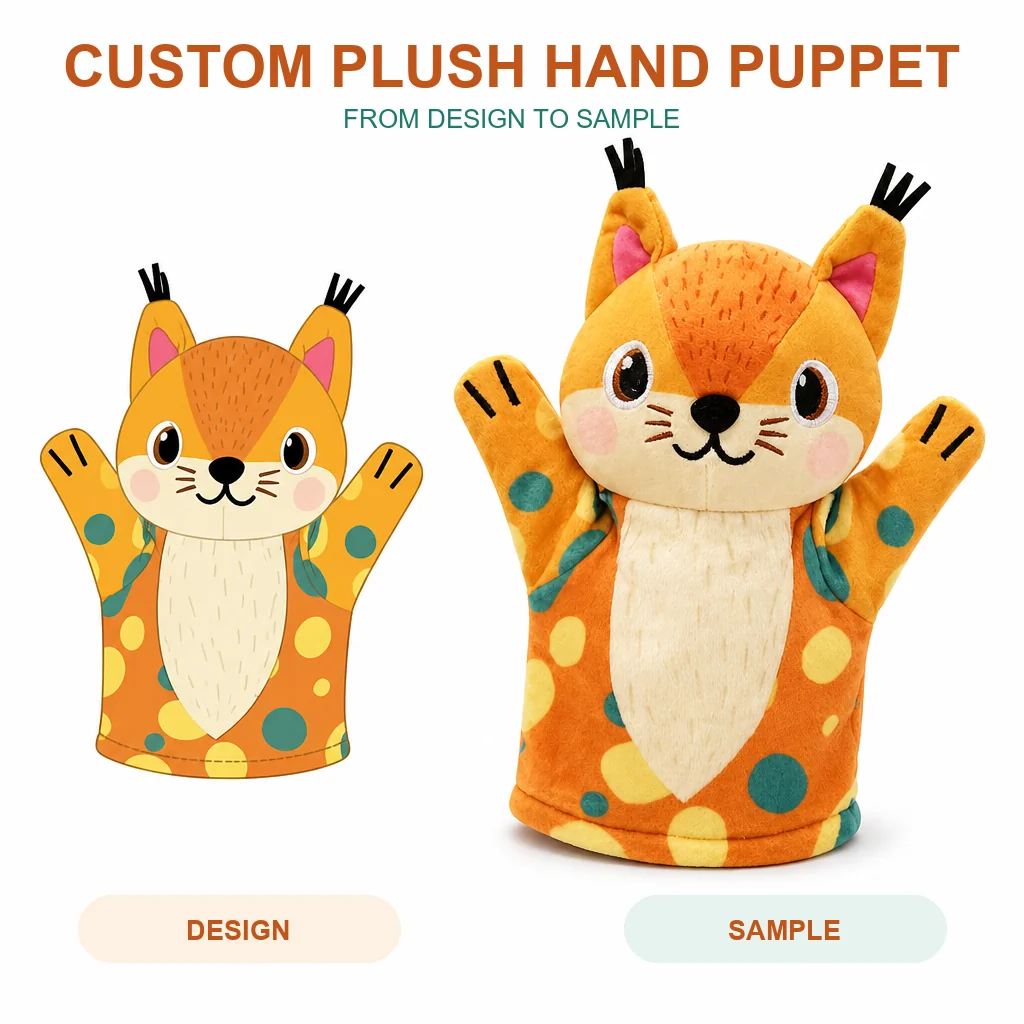
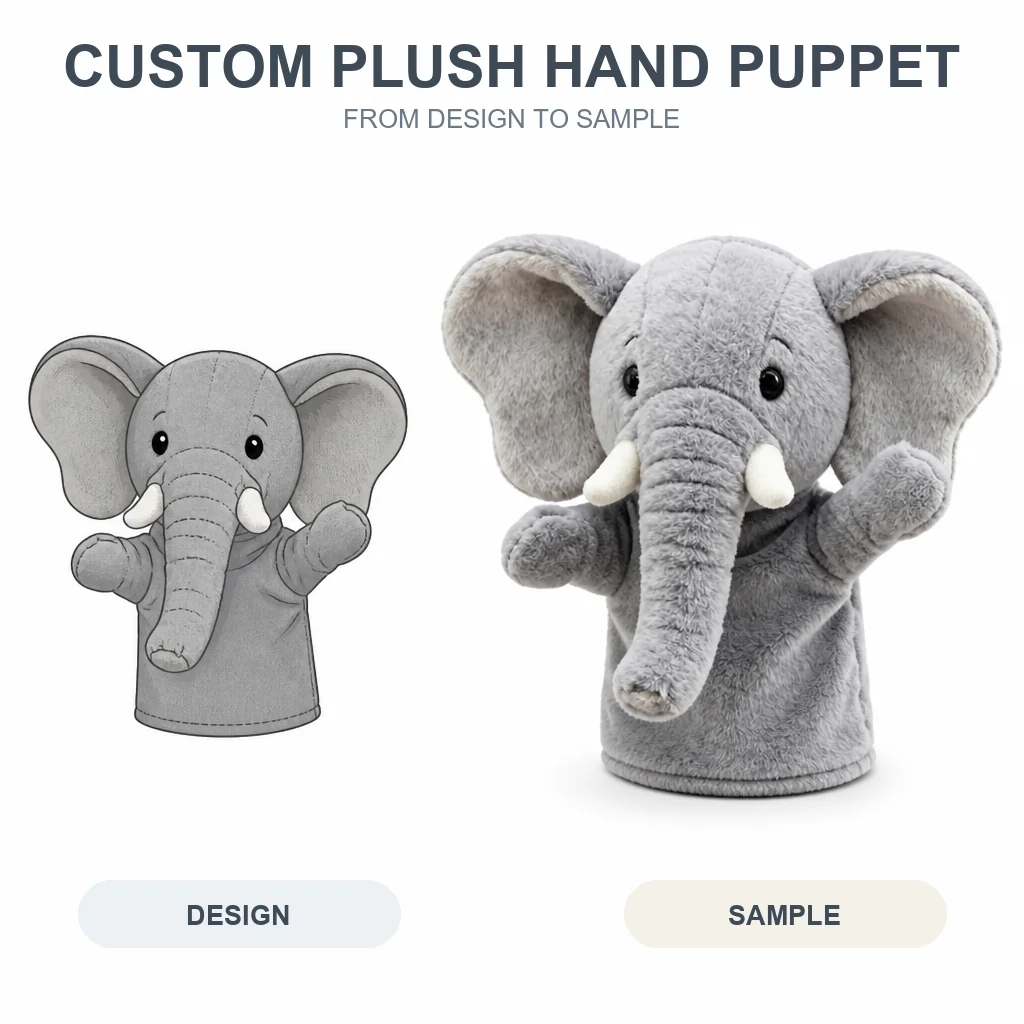
- Face: eyes and facial marks can be embroidered, appliqued or printed, or built from attached components; the photographs here show more than one approach. The method is reviewed against the design, the market and the intended age group.
- Pile and weight: a long pile hides seam shaping but blurs small detail; a shorter pile reads the face more clearly and takes embroidery well.
- Colour: match against a physical card or a Pantone reference in the light the product will be seen in; screen colour shifts.
- Inside: the lining and the hand pocket touch the operator, so both are agreed with the sample rather than from a photograph.
Fabric names, compositions and any performance claim are confirmed against the material actually selected for the project. A photograph shows appearance, not specification.
What To Send With Your Enquiry
A useful brief lets the pattern be assessed before a sample is quoted. Send what exists and mark what is still open, rather than waiting for a complete pack.
Design And Product Information
- Artwork or reference photographs: front, side and back, plus the mouth open and closed
- The format you need: whole-hand puppet, five-finger set or single finger puppet
- Finished size, and either hand measurements or a description of the operator
- Target market and intended age group, as your own requirement
- Decoration, packaging and labelling requirements
- Quantity per design and size, required date and destination
If only a front view exists, the project can still be assessed; the pattern maker will list the missing views before sampling. A 3D file can be an extra appearance reference, but the plush structure is still built from pattern pieces.
Order Basis
Custom orders start from 1 piece. There is no ready stock: a single piece also goes through sampling or production, and cost and lead time are confirmed for the project.
Fees depend on the format, the size, the number of pattern pieces and the decoration, so they are quoted against the design rather than published as a list price. Sample fees, revision scope and estimated timing are confirmed with the quotation.
Tell us which decision is fixed and which is still open — size, mouth type or colour — so the first sample tests the right question.
Review The Sample By Wearing It
A hand puppet sample is judged on the hand, not on a table. These four checks catch the problems that photographs hide.
- Check 1
Fit And Cuff
Put the sample on the operator it was designed for. The cuff should hold without pinching, the fingers should reach the mouth, and the body should not twist when the head turns.
- Check 2
Mouth Travel
Where the design has an operated mouth, work it through its full range and let it close. Check for a gap at the seam corners and watch whether the face distorts when the jaw opens.
- Check 3
Seams Under Load
Look at the points the hand pushes against: mouth corners, the head-to-body join, arm attachments and the eye and nose attachments.
- Check 4
Face And Colour At A Distance
Stand back to arm’s length and then to about a metre. Confirm the expression still reads and the colour blocks still separate.
Evidence To Ask For
- Front, side and back views, plus one view worn on the hand
- A short video of the mouth being worked, where the mouth moves
- A ruler photograph and a measured size table against the agreed dimensions
- Physical fabric cards and colour references; screen colour is a reference only
How Feedback Is Closed
Consolidate comments into one dated response per sample version, and separate a correction against the agreed brief from a new design request. The approved physical sample, its version and the approval date become the production reference; agree who holds it and how later changes are recorded.
Series, Variants And Add-Ons
A hand-puppet series usually varies size, outfit or animal. Anything that changes the outside shape needs its own pattern pieces and its own sample; a colour change on the same pattern is a smaller step, but it still needs its own approval.
- One body, several heads: check the balance on the hand before assuming a shared body works for every character.
- Outfits and props: attachment points are decided at pattern stage so they sit correctly on the filled body, and removable pieces are reviewed as small parts with your market requirement.
- Packaging per variant: individual packing, labels and carton marks differ by variant, so they are quoted with the design rather than added at the end.
Your Artwork And Files
Before sending unreleased artwork, agree the NDA, who may receive the files and whether samples or photographs may be shown. A bilateral non-disclosure agreement can be signed by Dongguan Orui Toys & Gifts Co., Ltd. or the actual contracting entity, and customer templates can be reviewed.
- Ownership: you keep the rights to your designs. The permitted use, ownership and delivery scope of production files such as patterns and bills of materials are agreed in the contract.
- No reuse: public display or use beyond the agreed project needs written permission from the rights holder.
- Access: agree who may open the files, how any participating workshop is covered, and whether files are returned or retained.
Manufacturing permission does not automatically include permission to use a character, a customer name or photographs in marketing.
Before Production Starts
Approval Checklist
- Approved sample, its version and approval date
- Final pattern and size chart, including the hand measurements used
- Bill of materials and colour standards against physical references
- Embroidery or print files and any special-part specification
- Labels, barcodes, individual packaging and carton requirements
- Test plan for the target market and intended age group
Schedule And Testing
The schedule starts when the sample is approved and the commercial terms, materials, packaging and any testing requirement are confirmed. Design or order changes need a fresh timing assessment; no single lead time applies to every project.
Orui can coordinate testing discussions with a third-party laboratory for the product, the intended age and the destination market. The required documents, test scope, samples and costs are agreed for that design, and a report applies only to the products and materials it covers. See Quality & Safety for the wider topic.
Custom Plush Hand Puppet Questions
Can One Design Be Made In Different Hand Sizes?
Yes, within limits. Hand length and palm width change the pattern, the hand pocket and the cuff, and each size is sampled and approved on its own. A larger or smaller version is not presented as an identical copy.
Is The Mouth Fixed Or Does It Move?
Both are possible as design options: a mouth finished open, or a mouth the operator works with the fingers. The photographs on this page show an open-mouth appearance, not the construction. The choice changes the pattern, the lining and the control path, and the movement is demonstrated on the sample before it is approved.
What Is The Difference Between A Hand Puppet And A Finger Puppet?
A whole-hand puppet is worn with the hand inside the body and is usually operated to move the mouth. A five-finger set carries one head on each finger and closes at a wrist cuff. A single finger puppet is worn on one finger. Each format has its own pattern count, detail limit and quote basis.
What Is The Minimum Order?
Custom orders start from 1 piece, and there is no ready stock. A single piece also goes through sampling or production, and cost and lead time are confirmed for the project.
Can You Work From A Drawing Only?
Yes, if the drawing shows the front, side and back or the missing views can be agreed. A single front view can be assessed, and the pattern maker will list the questions the drawing does not answer before sampling starts.
Can You Arrange Testing For My Market?
Orui can coordinate testing discussions with a third-party laboratory for the product, intended age and destination market. Confirm the laboratory, the applicable requirements, the costs and the report scope for your project; a report covers only what it was issued for.
Discuss Your Hand Puppet
Send the drawing or reference, the hand measurements or a description of the operator, the format you need and the quantity per design. We will confirm what is needed for the first assessment and the sample plan.
Use Request A Quote to prepare the brief, or email landy@oruitoys.com with the details.