
Compliance
Testing And Compliance Support
Testing follows the product, the market and the age group. This page explains what the buyer has to supply, what can be arranged, and what a report does and does not prove.
What Testing Support Means Here
The company supports testing; it does not certify products and does not operate a laboratory.
Compliance support means identifying which requirements plausibly apply to a product, arranging testing with a third-party laboratory, and passing the result to the buyer with its actual scope.
It does not mean that every product is certified, or that one report covers a factory, a material range or a future product. A report belongs to what was tested: the product, the material, the standard and the date.
Where a buyer already has a laboratory, a protocol or a market requirement, that takes precedence; the page describes the general route, not a substitute for the buyer’s own compliance obligations.
What The Buyer Has To Supply
Five inputs decide which tests apply. Missing any of them makes a quotation conditional.
- Destination marketWhere the goods will be sold or distributed. Different markets adopt different toy and textile requirements.
- Intended user and age groupWho uses the product and at what age. This is the single largest driver of which tests apply.
- Product use and claimsToy, collectible, promotional item, pet product or accessory, and any claim made on the packaging or listing.
- Materials and constructionSurface fabric, filling, trims, attachments and any electronic or magnetic part.
- Existing reports or buyer protocolAny report you already hold, and the standard or protocol your buyer requires.
Who Is Responsible For What
Compliance is shared, but not symmetrically. The buyer owns the market decision; the supplier owns the product evidence.
| Decision Point | What To Confirm | Why It Matters |
|---|---|---|
| Market And Legal Requirements | Buyer identifies the market and the legal obligations that apply there. | A supplier cannot choose the market on the buyer’s behalf. |
| Age Grading And Warnings | Buyer confirms intended age; wording is agreed before labels are printed. | Wrong grading invalidates the rest of the test plan. |
| Test Selection | Agreed jointly against product, market and age. | Testing the wrong standard wastes both time and money. |
| Laboratory And Testing | Third-party laboratory; the company coordinates sample submission. | No in-house laboratory is claimed. |
| Report Custody | Report is issued to the named applicant with its scope stated. | A report is not transferable to an untested product. |
| Ongoing Conformity | Buyer monitors changes in the market requirement; supplier declares material changes. | A material change can void prior evidence. |
How A Test Is Arranged
Five steps, with the decision that has to be closed at each.
Confirm Market And Age
Written confirmation of destination, intended user and any buyer protocol.
Select The Standard
Agree which requirements apply and which laboratory will run them.
Submit A Production-Representative Sample
The sample must match the material and construction that will be produced, not an earlier prototype.
Test And Report
The laboratory issues a report stating product, standard, method and result.
Apply The Result
Labels, warnings and packing are aligned with the tested configuration before production.
What A Report Contains, And What It Does Not
Reading the scope line matters more than reading the pass mark.
- What it states
- Product description, applicant, standard, test method, sample received date and result.
- What it covers
- The specific product, materials and construction submitted for that standard.
- What it does not cover
- Other products, later material changes, other markets, or the factory as a whole.
- Who holds it
- The applicant named on the report; a copy can be shared with the buyer of that project.
- Validity
- A report reflects the standard in force at the test date; later revisions are the buyer’s to track.
Which Document Answers Which Question
| Document | What It Covers | Who Is Responsible | Cost And Limits |
|---|---|---|---|
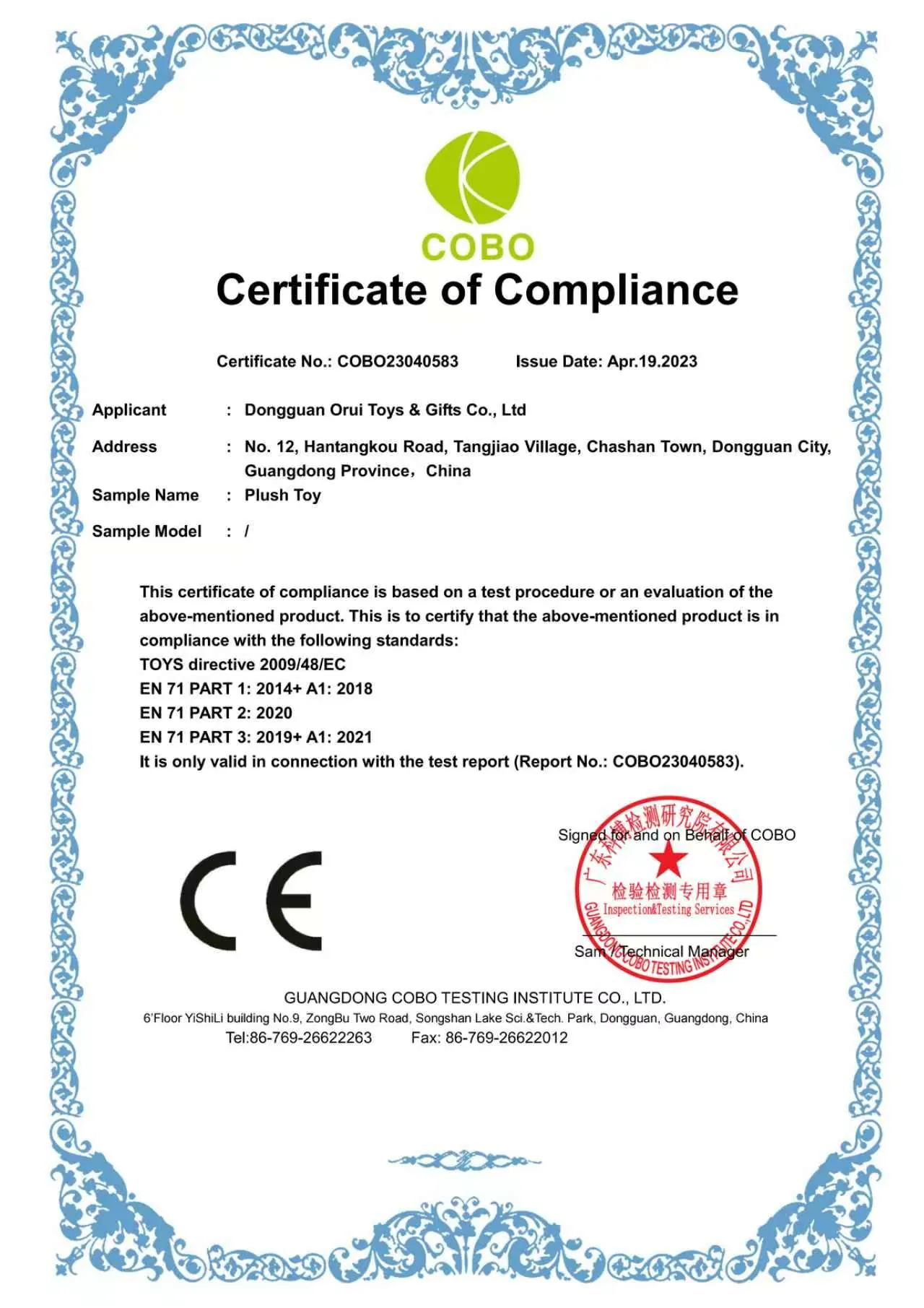
| EN 71 test report (COBO) | Results for the plush sample named in report COBO23040583 | The party that commissions the test; the laboratory performs and issues it | Fees quoted for the scope; covers the sample named |
| Certificate of compliance (COBO) | The named sample was evaluated against EN 71 parts 1–3, with CE marking | Issued by the testing body for the sample it tested | Follows the report; not a blanket statement for other designs |
| Children’s product certificate (CPC) | The product and rules named on the certificate, for the US market | Drafted and issued by the US manufacturer or, for overseas production, the US importer, based on testing at a CPSC-accepted third-party laboratory | Depends on applicable rules; confirmed per product and market. CPSC CPC FAQ |
| Factory assessment (SGS) | Production and trading capability at a point in time | Requested by buyer or platform; issued by the assessing body | Report 494022235 is valid to 30 Jul 2027 |
Each document is limited to the sample, standard and period named on it. Check the product, market and date with your compliance contact before relying on one.
When A Change Invalidates A Test
Any change to what was tested is a change to the evidence.
A different fabric, a different filling, an added attachment, a new decoration method or a changed age grading can each move the product outside the configuration that was tested.
When that happens the options are a new test, or a documented assessment by the laboratory of whether the change affects the result. Neither is automatic, and both take time.
The cheapest protection is to freeze the materials and construction before testing, rather than testing a prototype that will not be produced.
Material substitutions proposed after testing must be declared so the effect on the report can be assessed.
Questions About Testing
Four answers that keep the scope honest.
Which Standards Apply To Plush Toys?
It depends on the destination market and the intended age group. Common toy-safety frameworks include EN 71 in the EU and CPSIA/ASTM requirements in the United States, but which ones apply, and to which parts, is confirmed per product rather than assumed.
Can You Send A Certificate With The Quotation?
A report can be provided for a specific tested product. A general certificate for all products or for the factory is not available, because the evidence does not exist in that form.
Who Pays For Testing?
Testing is quoted as its own line rather than hidden inside the unit price. Who bears it is agreed in the quotation; it is not assumed.
Can We Use Our Own Laboratory?
Yes, when the buyer nominates an accredited laboratory and protocol. In that case the buyer’s protocol governs and the company coordinates sample submission.
State The Market And The Age Group First
Those two facts decide most of the test plan before any sample is sent.